
SAT Right Triangles and Trigonometry Worksheet
In a right triangle, with as the hypotenuse. For trig ratios, identify the angle first: sine is opposite over hypotenuse, cosine is adjacent over hypotenuse, and tangent is opposite over adjacent.

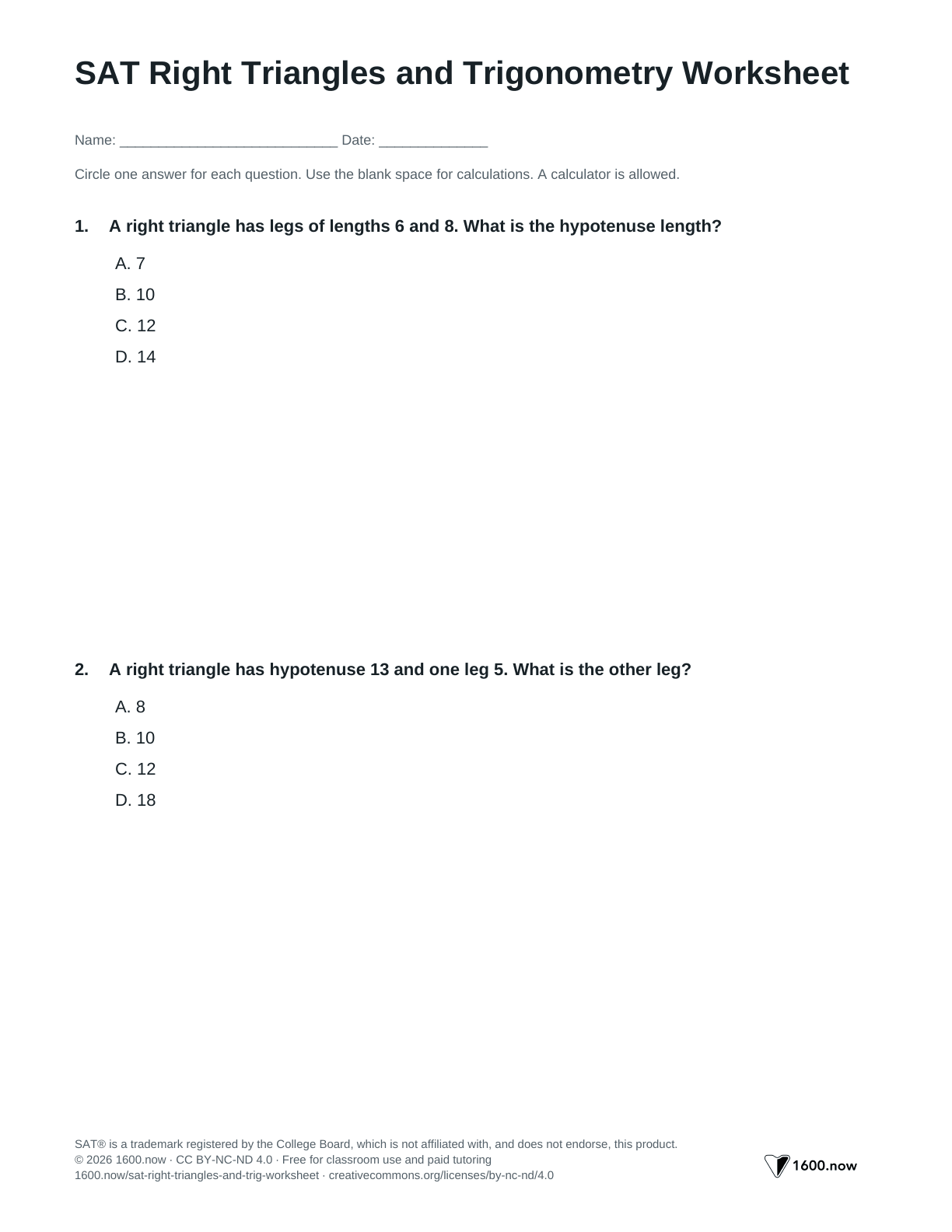
The 12 questions include missing sides, special right triangles, trig ratios, and similar triangles. Choose a student PDF or the explained answer-key version.
12 questions · about 25 minutes · Geometry and Trigonometry › Right triangles and trigonometry
Share to Google Classroom · This worksheet is free to print and share under CC BY-NC-ND 4.0. Tutors may also use it in paid sessions. If you post it online, please link to this page instead of re-uploading the PDF. These are original questions, not College Board items.
Label the sides from the named angle
The hypotenuse is opposite the right angle and is the longest side. The opposite and adjacent legs depend on which acute angle you use. The adjacent side in a tangent ratio is a leg, not the hypotenuse.
To find a missing leg, subtract its partner’s square from the hypotenuse’s square, then take the positive square root. For a –– triangle, , so the missing leg is .
A 45–45–90 triangle has side ratio . A 30–60–90 triangle has ratio , with the shortest side opposite 30 degrees. Match the named angle and side before scaling.
The acute angles in a right triangle are complementary, so when degrees. This is a useful check when the choices include the ratio for the other angle.
Try it yourself
Choose an answer.
Questions
Question 1
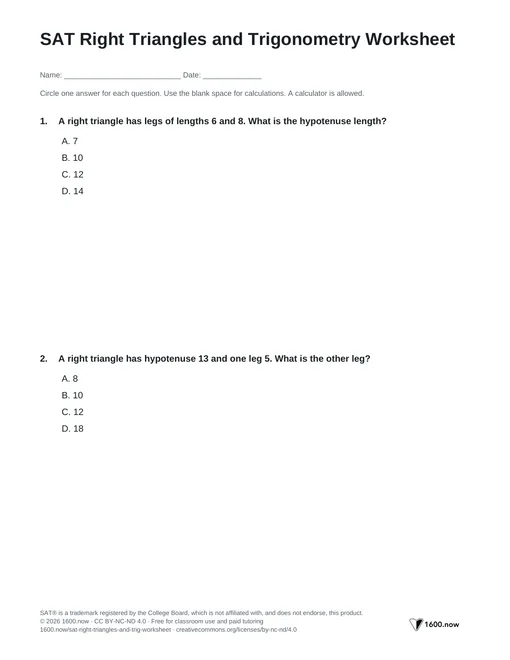
A right triangle has legs of lengths 6 and 8. What is the hypotenuse length?
B. The Pythagorean theorem gives . Taking the positive square root gives .
Question 2
A right triangle has hypotenuse 13 and one leg 5. What is the other leg?
C. The missing leg has squared length , so its length is 12.
Question 3
In a 45-45-90 triangle, each leg has length 4. What is the hypotenuse length?
B. A 45-45-90 triangle has side ratio 1:1:. Multiply the leg length 4 by .
Question 4
In a 30-60-90 triangle, the side opposite 30° is 5. What is the hypotenuse length?
C. The hypotenuse is twice the short leg in a 30-60-90 triangle. Thus it has length .
Question 5
For an acute angle A in a right triangle, the opposite side is 3 and the hypotenuse is 5. What is ?
A. Sine is opposite divided by hypotenuse. The specified side lengths give .
Question 6
For an acute angle B in a right triangle, the adjacent leg is 8 and the hypotenuse is 17. What is ?
B. Cosine is adjacent leg divided by hypotenuse. Therefore .
Question 7
In the triangle shown, what is ?
B. Angle A is at the top. Its opposite side is , and the hypotenuse is . Thus .
Question 8
In the triangle shown, what is ?
C. For angle C, the opposite leg is and the adjacent leg is . Thus .
Question 9
The acute angles A and B of a right triangle are complementary. If , what is ?
A. For complementary angles, . Therefore has the same value, .
Question 10
A 10-foot ladder forms a right triangle with a vertical wall and level ground. Its base is 6 feet from the wall. How high does it reach?
C. The ladder is the hypotenuse. The height satisfies , so and .
Question 11
A right triangle has one acute angle of 35°. What is the other acute angle?
B. The two acute angles of a right triangle sum to 90°. Subtracting 35 gives 55°.
Question 12
Two similar right triangles have hypotenuse lengths 10 and 15. A leg in the smaller triangle is 4. What is the corresponding leg in the larger triangle?
B. The scale factor is . Multiply the corresponding smaller leg by 1.5: .
0/12 correct
Check your trigonometry answers
Each row is a wrong answer choice from one of the sheet's problems. Find the one you picked, then run the check in the last column.
| What your answer looked like | What actually happened | Fix it next time |
|---|---|---|
| 14 in problem 1 | You added the legs, . The Pythagorean theorem adds their squares. | , so the hypotenuse is 10. |
| 8 in problem 2 | You subtracted the lengths, . Subtract the squares instead. | , so the other leg is 12. Check: . |
| in problem 4 | is the leg opposite the 60-degree angle. The question asks for the hypotenuse. | In a 30-60-90 triangle, the hypotenuse is twice the short leg: . |
| in problem 7 | uses , the leg that touches angle . That's . | The side opposite is , so . |
| in problem 9 | is . The question asks for . | In a right triangle, the side opposite is adjacent to , so . |
| 9 in problem 12 | You added the difference between the hypotenuses, , to the leg. Similar triangles scale by multiplying. | The scale factor is , so the leg is . |
Worked example: tangent from a figure
Problem 8 shows right triangle with the right angle at , , , and , and asks for . Start at . The side opposite is the one that doesn't touch it, . The adjacent leg touches and isn't the hypotenuse, so it's .
Tangent is opposite over adjacent, so . From , the two legs switch roles, which is where comes from: it's . The choices and use the hypotenuse, so they're and .
Apply the check to fresh questions
On the next trig question, label opposite, adjacent, and hypotenuse from the named angle before forming a ratio. Continue with right-triangle practice below.
Review the right triangles and trigonometry method