
SAT Lines, Angles, and Triangles Worksheet
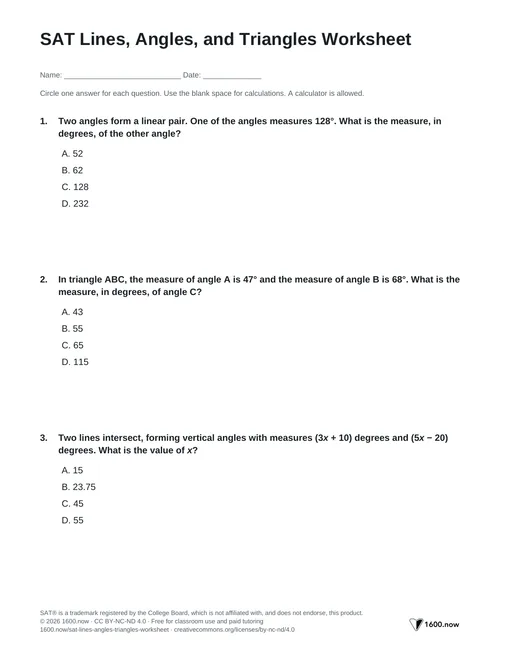
For angle questions, mark the rule that links the angles: a straight line totals 180 degrees, vertical angles are equal, and a triangle’s interior angles total 180 degrees. Parallel-line relationships require the lines to be marked or stated parallel.

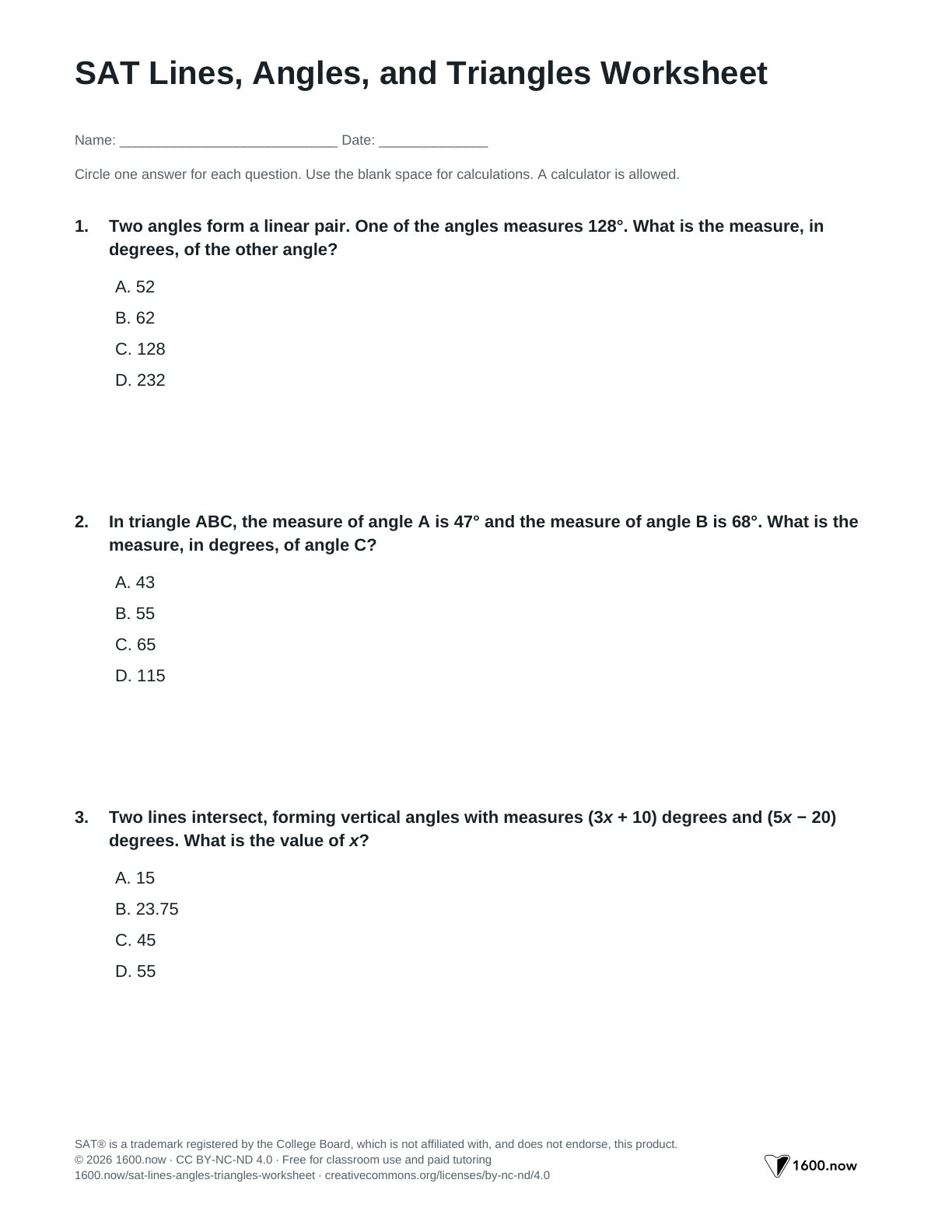
The 12 questions below also cover exterior angles and similar triangles. Print the student copy or download the Letter/A4 PDF with explained answers.
12 questions · about 25 minutes · Geometry and Trigonometry › Lines, angles, and triangles
Share to Google Classroom · This worksheet is free to print and share under CC BY-NC-ND 4.0. Tutors may also use it in paid sessions. If you post it online, please link to this page instead of re-uploading the PDF. These are original questions, not College Board items.
Name the angle relationship or corresponding sides
For a transversal across parallel lines, identify positions before writing an equation. Corresponding and alternate interior angles are equal; same-side interior angles are supplementary. The drawing’s apparent size cannot replace the stated relationship.
A triangle’s exterior angle equals the sum of its two remote interior angles. You can also find the adjacent interior angle first and subtract it from 180 degrees. Both methods should give the same result.
For similar triangles, match vertices and sides before forming a ratio. Use whole sides consistently: a side made of segments and has total length , so its ratio to the -unit corresponding side is , not .
Write each intermediate value next to the exact angle or segment it measures. The final question may request the adjacent exterior angle or the remaining segment instead.
Try it yourself
Choose an answer.
Questions
Question 1
Two angles form a linear pair. One of the angles measures 128°. What is the measure, in degrees, of the other angle?
A. Angles that form a linear pair add to 180 degrees, so the other angle measures degrees. Choice D subtracts from 360 degrees instead.
Question 2
In triangle ABC, the measure of angle A is 47° and the measure of angle B is 68°. What is the measure, in degrees, of angle C?
C. The angles of a triangle add to 180 degrees, so angle C measures degrees. Choice D is the sum of angles A and B.
Question 3
Two lines intersect, forming vertical angles with measures degrees and degrees. What is the value of ?
A. Vertical angles are equal, so . Then and . Choice D is the angle measure, , and choice B treats the angles as supplementary.
Question 4
In the figure, lines and are parallel. What is the value of ?
C. Because and are parallel, the angle to the left of at line is also 115°; the two are corresponding angles. That angle and form a straight line, so . Choice D assumes the two marked angles are equal.
Question 5
In triangle PQR, and the measure of angle P is 40°. What is the measure, in degrees, of angle Q?
B. Since , the angles opposite those sides, angles R and Q, are equal. Together they measure , so each is 70°. Choice D is their combined measure.
Question 6
In the figure, points B, C, and D lie on a line. What is the value of ?
D. The angles of triangle ABC add to 180°, so angle ACB is . Angle forms a straight line with angle ACB, so . That equals , the sum of the angles at A and B. Choice B is angle ACB.
Question 7
In triangle XYZ, the measure of angle X is 20° greater than the measure of angle Y, and the measure of angle Z is twice the measure of angle Y. What is the measure, in degrees, of angle Z?
D. Let angle Y be degrees. Then , so and . Angle Z is . Choices A and B are the measures of angles Y and X.
Question 8
In the figure, segment DE is parallel to segment BC. What is the length of BC?
D. Because DE is parallel to BC, triangle ADE is similar to triangle ABC. , so BC is times DE, and . Choice A uses the ratio of DB to AD instead of AB to AD.
Question 9
What is the measure, in degrees, of each interior angle of a regular octagon?
C. Diagonals from one vertex split an octagon into 6 triangles, so its angles add to . Dividing 1,080 by 8 equal angles gives 135°. Choice D is the sum of all 8 angles.
Question 10
Two parallel lines are cut by a transversal. Two same-side interior angles have measures degrees and degrees. What is the value of ?
B. Same-side interior angles between parallel lines add to 180°: . Then and . Choice A comes from setting the angles equal, which applies to alternate interior angles, not same-side interior angles.
Question 11
Triangle ABC is similar to triangle DEF, with A, B, and C corresponding to D, E, and F. In triangle ABC, , , and . The perimeter of triangle DEF is 30. What is the length of EF?
B. The perimeter of triangle ABC is , so triangle DEF is times as large. EF corresponds to BC, so . Choice C scales AC instead of BC.
Question 12
In the figure, segment AB is parallel to segment DE, and segments AE and BD intersect at point C. If , , and , what is the length of AC?
A. Since AB is parallel to DE, triangle ABC is similar to triangle EDC, with AC matching EC. So AC and EC are in the ratio 8 to 12, or 2 to 3. Splitting into 5 equal parts gives and . Choice C is EC.
0/12 correct
Check your angles and triangles answers
Each row is a wrong answer choice from one of the sheet's problems. Find the one you picked, then run the check in the last column.
| What your answer looked like | What actually happened | Fix it next time |
|---|---|---|
| 55 in problem 3 | 55 is the angle measure, . The question asks for . | Set the vertical angles equal: , so . Both angles then measure 55 degrees. |
| 115 in problem 4 | The 115-degree angle and aren't in matching positions. The angle that matches 115 degrees at line sits just left of , on the same straight line. | Find the corresponding angle first: 115 degrees, above and left of the transversal. It forms a straight line with , so . |
| 65 in problem 6 | 65 is angle , inside the triangle. Angle is outside it, between and . | and angle make a straight line: . Check: an exterior angle equals the sum of the two far interior angles, . |
| 7.5 in problem 8 | You scaled by . The similar triangles are and , which share vertex . | Compare whole sides from : , so the scale is and . |
| in problem 10 | You set the two angles equal. That rule is for alternate interior angles. Same-side interior angles add to 180 degrees. | , so and . Check: . |
| 12 in problem 11 | 12 scales , but matches . The order of the letters tells you: goes with , and goes with . | The perimeters give the scale, , so . |
Worked example: similar triangles that cross
Problem 12 has segments and crossing at , with parallel to . The parallel sides make alternate interior angles equal, and the angles at are vertical angles, so triangle is similar to triangle . matches , matches , and matches .
The scale is , so and are in the ratio 2 to 3. Together they make . Split 25 into equal parts of 5: and . The choice 15 is , and 12.5 puts at the midpoint of .
Apply the check to fresh questions
For your next figure, mark angle measures and side correspondences before calculating. Use lines-and-triangles practice to check both the rule and the exact quantity requested.
Review the lines, angles, and triangles method