
SAT Vocabulary Worksheet
To answer a words-in-context question, predict a plain-language meaning for the blank, then choose the word that fits both that meaning and the sentence. A word that sounds academic can still contradict the passage.

These 12 vocabulary questions give short passages with one blank and four choices. Print the student worksheet for a blind attempt, use the answer-key PDF for explanations, or answer directly below.
12 questions · about 25 minutes · Craft and Structure › Words in Context
Share to Google Classroom · This worksheet is free to print and share under CC BY-NC-ND 4.0. Tutors may also use it in paid sessions. If you post it online, please link to this page instead of re-uploading the PDF. These are original questions, not College Board items.
Use the clue nearest the blank
Cover the choices and underline what the text establishes. A contrast such as "rather than established" tells you that the explanation is unsettled. An example or definition after the blank can tell you exactly what the missing word means.
Give the blank a simple substitute: uncertain, too little, agreement, or limited. Then compare the choices to that prediction. Do not let a familiar word pull you away from the clue; economy can mean avoiding waste, including waste of words.
Read the whole sentence with your choice inserted. Check its meaning, its strength, and the way it combines with nearby words. If two options seem possible, name the precise phrase that rules one out. Record the word with its clue rather than memorizing a definition alone.
Try it yourself
Choose an answer.
Questions
Question 1
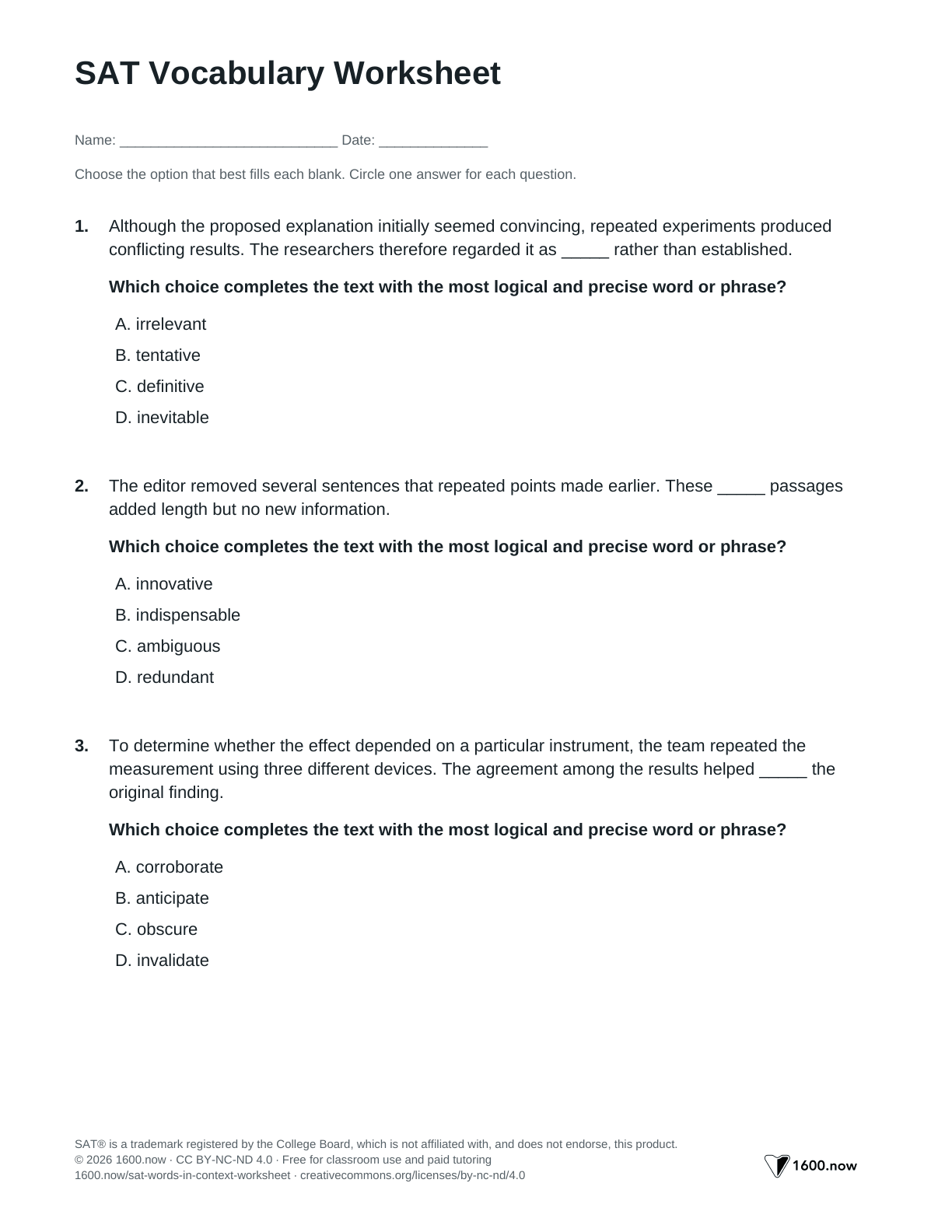
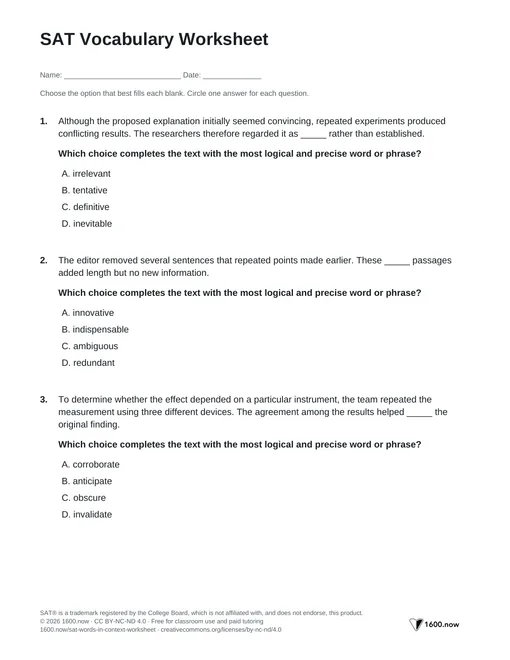
Although the proposed explanation initially seemed convincing, repeated experiments produced conflicting results. The researchers therefore regarded it as _____ rather than established.
Which choice completes the text with the most logical and precise word or phrase?
B. Tentative means provisional or uncertain. Conflicting results prevent the explanation from being established. Definitive and inevitable are too certain; irrelevant would mean it has no bearing on the issue.
Question 2
The editor removed several sentences that repeated points made earlier. These _____ passages added length but no new information.
Which choice completes the text with the most logical and precise word or phrase?
D. Redundant means needlessly repetitive. The sentences repeat earlier points. Ambiguous means unclear, innovative means new, and indispensable means essential.
Question 3
To determine whether the effect depended on a particular instrument, the team repeated the measurement using three different devices. The agreement among the results helped _____ the original finding.
Which choice completes the text with the most logical and precise word or phrase?
A. Corroborate means support with additional evidence. Agreement across devices supports the finding; it does not hide it, predict it, or show it to be invalid.
Question 4
The historian did not claim that the surviving letters described every aspect of daily life. Instead, she _____ her conclusion to the household activities that the letters explicitly discussed.
Which choice completes the text with the most logical and precise word or phrase?
C. Restricted means limited. The historian limits her conclusion to the activities covered by the evidence. Extended would express the opposite action.
Question 5
Because the committee members disagreed about nearly every detail, the few points of _____ became the foundation of their final proposal.
Which choice completes the text with the most logical and precise word or phrase?
B. Consensus means agreement. The contrast between widespread disagreement and a few shared points identifies the needed meaning. Contention and divergence signal disagreement.
Question 6
The poet uses a spare style: each image is expressed in a few carefully chosen words. Critics admire this _____, which allows a brief line to convey a complex idea.
Which choice completes the text with the most logical and precise word or phrase?
A. Economy can mean careful, efficient use of something, here words. The passage praises concise expression, not decorative language, uncertainty, or inconsistency.
Question 7
The two engineers arrived at different estimates because they used different assumptions. Once they agreed on the assumptions, the apparent _____ between their results disappeared.
Which choice completes the text with the most logical and precise word or phrase?
A. A discrepancy is a difference or inconsistency. The estimates initially differ, but that difference disappears after the assumptions are aligned.
Question 8
Rather than announce a fixed schedule, the organizer kept the program _____ so that sessions could be moved if speakers arrived late.
Which choice completes the text with the most logical and precise word or phrase?
B. Adaptable means able to change with circumstances. Moving sessions requires flexibility, not a rigid or unchangeable schedule.
Question 9
The critic praised the essay for acknowledging evidence against its own argument. This willingness to address competing views made the analysis more _____ than a one-sided account would have been.
Which choice completes the text with the most logical and precise word or phrase?
C. Balanced describes fair consideration of multiple sides. Addressing contrary evidence adds balance; it does not make the essay evasive or absolute.
Question 10
The researcher found only two damaged fragments of the inscription. Because the evidence was so _____, she could not confidently reconstruct the entire message.
Which choice completes the text with the most logical and precise word or phrase?
D. Scant means scarce or insufficient in quantity. Two damaged fragments provide too little evidence to reconstruct the full inscription confidently.
Question 11
The architect retained the building's old brick walls but added large windows and open work areas. Her aim was to _____ its historic character with present-day needs.
Which choice completes the text with the most logical and precise word or phrase?
A. Reconcile means bring into agreement or compatibility. The design preserves historic features while accommodating present-day use, combining rather than replacing them.
Question 12
During rehearsal, the conductor asked the brass players to lower their volume so that the quieter woodwind melody would remain _____.
Which choice completes the text with the most logical and precise word or phrase?
B. Audible means able to be heard. Lowering the competing brass volume lets listeners hear the woodwind melody.
0/12 correct
Check your vocabulary answers
Each row is a wrong answer choice from one of the sheet's problems. Find the one you picked; the last column shows which words in the passage decide the blank.
| What your answer looked like | What actually happened | Fix it next time |
|---|---|---|
| Definitive in problem 1 | Definitive sounds like a word a research passage would use, but “conflicting results” and “rather than established” say the explanation is not settled. | Treat “rather than” as a flag: the blank is the opposite of the word after it. The opposite of established here is tentative, meaning uncertain and open to change. |
| Extended in problem 4 | The first sentence says the historian did not claim the letters covered every part of daily life. Extended would mean she widened her conclusion, the opposite of what “Instead” sets up. | After “Instead,” the blank does the reverse of what the previous sentence ruled out. She kept her conclusion to what the letters discussed: restricted. |
| Contention or divergence in problem 5 | Both words mean disagreement, which matches the rest of the passage. But the blank names “the few points” that stand apart from that disagreement, so it needs the opposite. | Find the contrast: disagreement about “nearly every detail” against “the few points of _____.” Those few points are points of agreement: consensus. |
| Ornamentation or hesitation in problem 6 | If you skipped economy because it sounded like a money word, check its other meaning: careful use that avoids waste, here of words. Ornamentation means decoration, the opposite of “a spare style.” Hesitation would mean the poet sounds unsure, which the passage never says. | Don't rule out a familiar word until you've tried its other meanings. The passage defines the blank for you: “each image is expressed in a few carefully chosen words.” |
| Consistency in problem 7 | The engineers “arrived at different estimates.” What disappeared once they agreed on assumptions was the difference between their results. | Ask what the passage says went away. A difference that goes away is a discrepancy. |
| Abundant or conclusive in problem 10 | The researcher found “only two damaged fragments” and “could not confidently reconstruct” the message. Abundant and conclusive describe the opposite situation. | Predict first: too little evidence. Scant means barely enough or not enough. |
Worked example: predicting the word before reading the choices
Problem 11 describes an architect who “retained the building's old brick walls but added large windows and open work areas.” The blank sentence reads: “Her aim was to _____ its historic character with present-day needs.” Cover the choices. She keeps the old and adds the new, so the blank means something like “fit together.”
Now read the choices: reconcile, conceal, separate, replace. Reconcile means to make two things compatible, which matches the prediction. Replace and conceal contradict “retained the building's old brick walls,” and separate is the opposite of fitting them together.
Apply the check to fresh questions
For another vocabulary attempt, write your prediction before opening the choices. After checking, copy the clue beside the word you missed. Use the Words in Context practice link below.
Review the words in context method