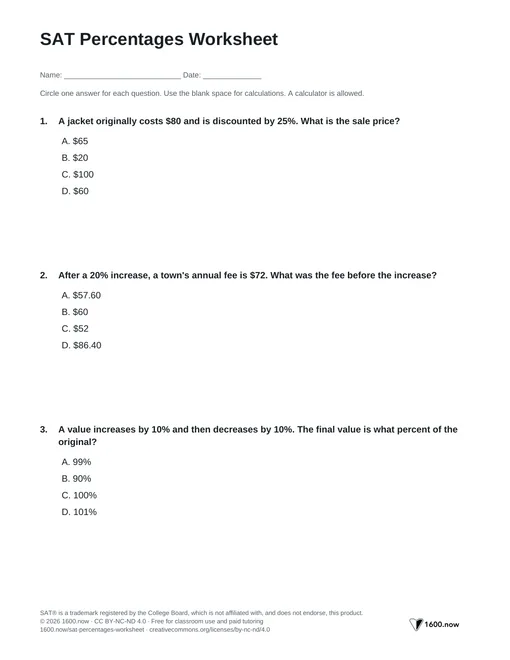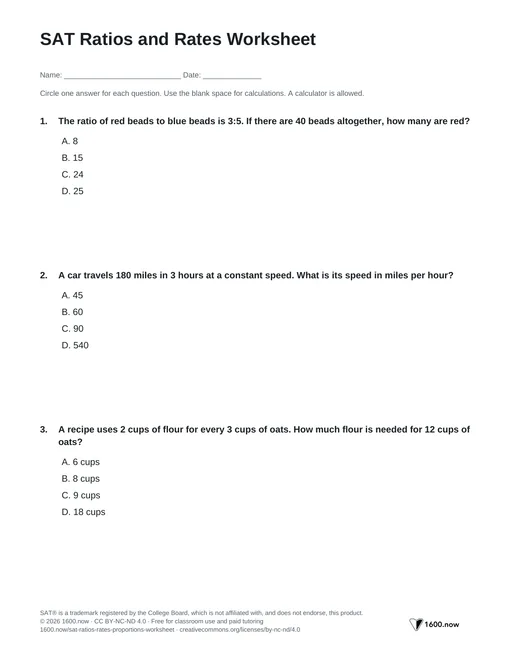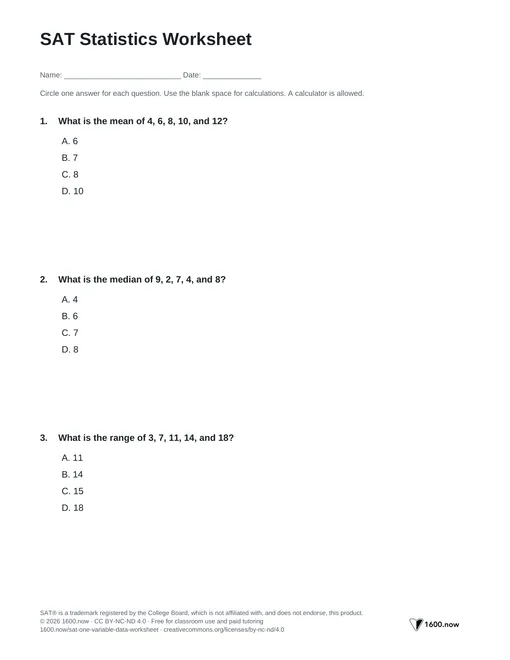

SAT Two-Variable Data Worksheet
A model predicts an output from an input. Read the variables and units before interpreting its slope, intercept, growth factor, or residual. A point above a fitted line has an observed output greater than the prediction.

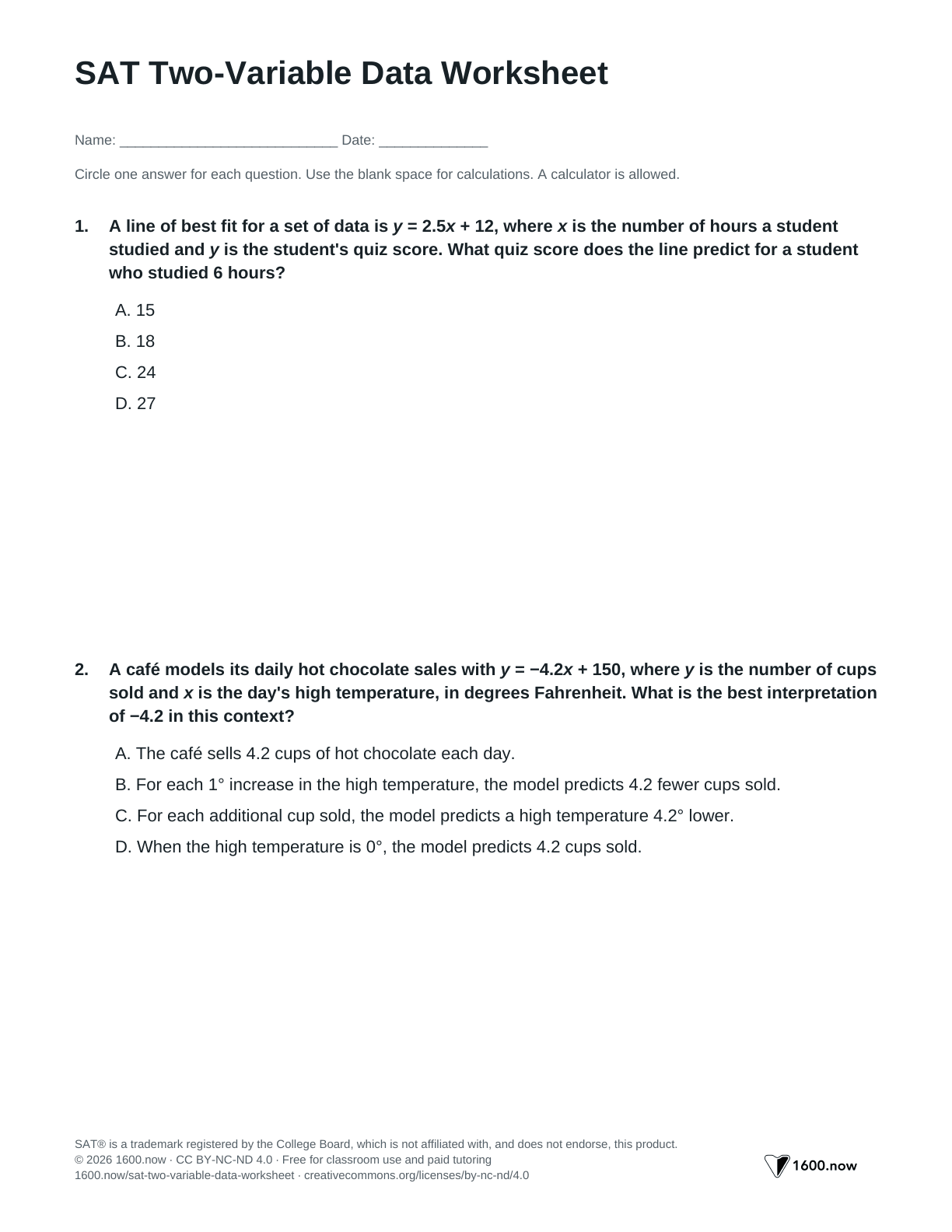
This 12-question worksheet covers scatterplots, lines of best fit, residuals, and exponential models. Choose a printable student version or an explained answer-key PDF.
12 questions · about 25 minutes · Problem-Solving and Data Analysis › Two-variable data: Models and scatterplots
Share to Google Classroom · This worksheet is free to print and share under CC BY-NC-ND 4.0. Tutors may also use it in paid sessions. If you post it online, please link to this page instead of re-uploading the PDF. These are original questions, not College Board items.
Compare the observation with the model
For , the slope is the predicted output change per input unit, and the intercept is the prediction at input zero. That zero-input prediction may lie outside the observed range; it is not automatically a measured fact.
A residual is observed minus predicted. If a model predicts 36 and the observed value is 38, the residual is , placing the point above the line. Negative residuals correspond to points below it.
To distinguish linear and exponential patterns at equally spaced inputs, compare consecutive differences and ratios. A constant difference suggests linear growth; a constant ratio suggests exponential growth. For , 92% remains each step, so the decrease is 8%.
Separate prediction from observation and stay aware of the input range used to fit the model. A relationship in a scatterplot does not by itself establish why one variable changes with the other.
Try it yourself
Choose an answer.
Questions
Question 1
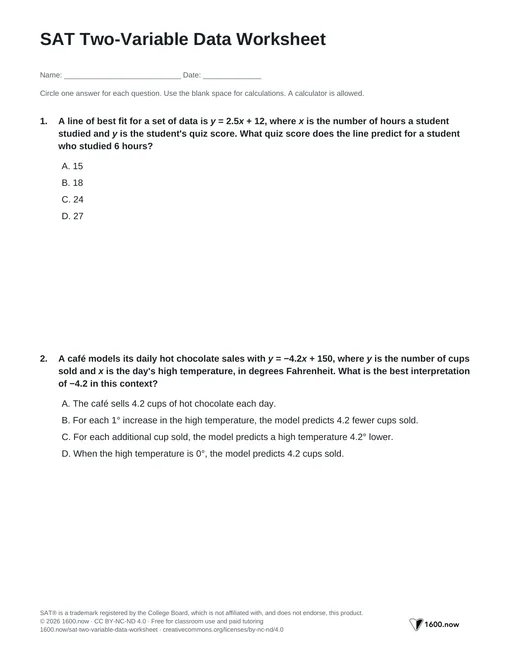
A line of best fit for a set of data is , where is the number of hours a student studied and is the student's quiz score. What quiz score does the line predict for a student who studied 6 hours?
D. Substitute : . Choice A leaves out the 12.
Question 2
A café models its daily hot chocolate sales with , where is the number of cups sold and is the day's high temperature, in degrees Fahrenheit. What is the best interpretation of in this context?
B. The slope, , is the change in predicted cups sold for each 1-degree increase in the high temperature. The negative sign means fewer cups on warmer days. Choice D describes the -intercept, which is 150.
Question 3
The scatterplot shows hours of practice and the number of errors on a typing test for 10 students. Which statement best describes the data?
C. The points fall from left to right in a roughly straight pattern, so errors tend to decrease as practice increases. Choice D is too strong: a student with 3 hours of practice made more errors than a student with 2 hours.
Question 4
A biologist used data on trees that were 5 to 40 years old to find a line of best fit for tree height and age. For which tree age is a prediction from this line least reliable?
D. Ages 8, 20, and 35 are inside the 5-to-40-year range of the data. At 90 years the line is used far outside that range, where the data give no evidence that the same trend holds.
Question 5
A line of best fit for a data set is . The data set includes the point (10, 38). How much greater is the actual -value of this point than the -value the line predicts?
A. At , the line predicts . The actual value, 38, is greater. Choice D is the predicted value itself.
Question 6
The scatterplot shows 9 data points and a line of best fit. For how many of the data points is the actual -value greater than the -value predicted by the line of best fit?
B. A point has an actual value greater than the prediction when it lies above the line. Four points lie above the line, at , 3, 6, and 8. The other 5 lie below it.
Question 7
A line of best fit for data on used cars is , where is a car's estimated value, in dollars, and is the car's age, in years. What is the best interpretation of 24,000 in this context?
C. When , , so 24,000 is the estimated value, in dollars, of a car that is 0 years old. Choice A describes the slope, −1,800. Choice D is too strong because the line gives estimates, not the value of each car.
Question 8
The scatterplot shows the age and height of 9 sunflower seedlings, along with a line of best fit. Which equation best represents the line of best fit, where is the height, in centimeters, and is the age, in weeks?
A. The line crosses the -axis at 10 and rises to 35 at , a slope of . Choice B swaps the slope and the -intercept, and choice C divides the change in by the change in .
Question 9
0 200 1 240 2 288 3 346 The table shows the number of members in an online group months after the group started. Which equation best models the data?
A. Each value is about 1.2 times the one before: and . With 200 members at , the model is . Choice B fits the first two rows, but it predicts 280 at , not 288.
Question 10
The function models the number of fish in a lake years after 2020. According to the model, how does the number of fish change each year?
B. Each year the number of fish is multiplied by 0.92, which keeps 92% of the fish and removes 8%. So the model predicts an 8% decrease each year.
Question 11
A scientist models the number of cells in a sample hours after it was prepared with the function , for positive constants and . The model gives and . What does the model predict for P(4)?
C. , so . Then , so and . The prediction is . Choice A assumes the count grows by the same amount each hour.
Question 12
The line of best fit for a data set is . A new data set is made by adding 3 to every -value in the original data set and keeping the -values the same. Which equation is the line of best fit for the new data set?
D. Adding 3 to every -value moves every point up 3 units without changing their pattern, so the line moves up 3 units too. The slope stays 4, and the -intercept becomes .
0/12 correct
Check your scatterplot answers
Each row is a wrong answer choice from one of the sheet's problems. Find the one you picked, then run the check in the last column.
| What your answer looked like | What actually happened | Fix it next time |
|---|---|---|
| 15 in problem 1 | 15 is . The model also adds 12. | Substitute into the whole equation: . |
| 36 in problem 5 | 36 is the line's prediction at . The question asks how far the actual value, 38, is above it. | Subtract the predicted value from the actual one: . |
| 5 in problem 6 | Five points are below the line. An actual value greater than the prediction puts a point above the line. | Compare each point with the line . The points at , 3, 6, and 8 are above it, so the answer is 4. |
| in problem 8 | You divided the change in by the change in : . | Slope is rise over run. The line rises from 10 to 35 while goes from 0 to 10, so the slope is . |
| in problem 9 | It fits the first two rows, but at it predicts 280, and the table says 288. The group grows by a factor, not by a fixed amount. | Divide consecutive values: . A constant ratio means . |
| “It decreases by 92%” in problem 10 | 0.92 is the fraction of fish that remain each year. A 92% decrease would leave only 8%. | Subtract the factor from 1: , an 8% decrease each year. |
Worked example: an exponential model from two values
Problem 11 models a cell count with , where and , and asks for . At , , so . Then , which gives and .
So . A quicker route: from to is two more hours, which multiplies the count by again, and . The choice 8,500 adds the same 4,000 cells every two hours, which is linear growth. The choice 13,500 multiplies by 3 only once, which covers one hour instead of two.
Apply the check to fresh questions
For the next model, describe its slope or factor in the question’s units and distinguish the predicted value from the observed one. Use two-variable-data practice for another comparison.
Review the two-variable data: models and scatterplots method