
SAT Transitions Worksheet
A transition names the relationship between two ideas: a contrast, a result, an example, an addition, a restatement, or a step in a sequence. Decide which relationship the sentences express before comparing transition words.

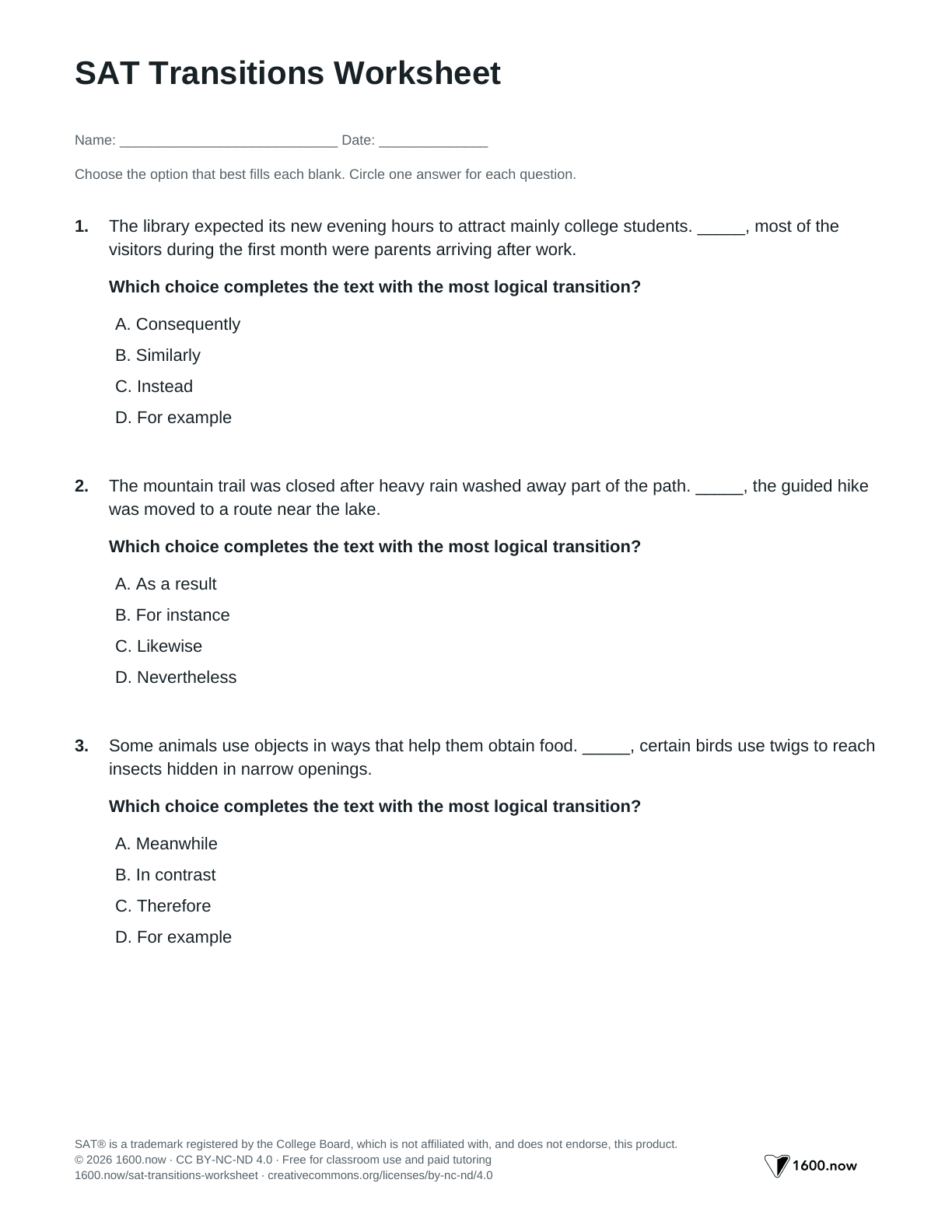
The 12 questions below include all of those relationships, plus comparison and events happening at the same time. Download a student worksheet or the version with explained answers in Letter or A4.
12 questions · about 25 minutes · Expression of Ideas › Transitions
Share to Google Classroom · This worksheet is free to print and share under CC BY-NC-ND 4.0. Tutors may also use it in paid sessions. If you post it online, please link to this page instead of re-uploading the PDF. These are original questions, not College Board items.
Translate the connection into a short phrase
Read the sentence before the blank and the sentence after it. Replace the blank with a rough phrase such as "because of that," "despite that," or "one example is." This makes the logical connection explicit before the wording of an answer can distract you.
A result follows because of the first idea. A concession happens despite it. An example gives one instance of a broader claim; a restatement says the same idea in different words. Two events occurring together do not, by themselves, make one a result of the other.
In a passage with more than two sentences, identify the ideas the blank actually joins. A sentence listing another feature may add to the immediately preceding sentence even when an earlier sentence discussed a contrast. Read your completed passage once to confirm the scope.
Try it yourself
Choose an answer.
Questions
Question 1
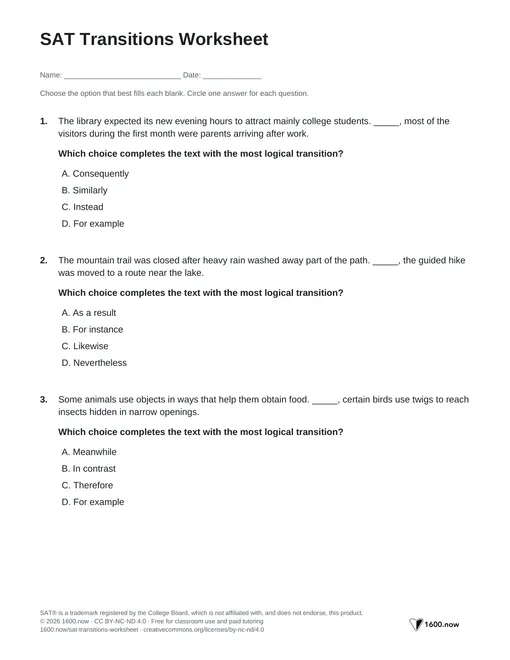
The library expected its new evening hours to attract mainly college students. _____, most of the visitors during the first month were parents arriving after work.
Which choice completes the text with the most logical transition?
C. Instead contrasts the expected audience with the actual one. The second sentence is neither an example of college attendance nor a consequence of that expectation.
Question 2
The mountain trail was closed after heavy rain washed away part of the path. _____, the guided hike was moved to a route near the lake.
Which choice completes the text with the most logical transition?
A. As a result introduces the consequence of the trail closure. Nevertheless would suggest that the move occurred despite the closure, which reverses the logic.
Question 3
Some animals use objects in ways that help them obtain food. _____, certain birds use twigs to reach insects hidden in narrow openings.
Which choice completes the text with the most logical transition?
D. For example introduces a specific instance of the general behavior described in the first sentence. The bird behavior illustrates object use.
Question 4
The first map records where the town's public wells stood in 1850. _____, the second map marks the locations of its public wells in 1900, allowing researchers to compare access over time.
Which choice completes the text with the most logical transition?
B. Similarly links two maps that perform the same kind of task for different years. The later date does not make the second map a consequence of the first.
Question 5
The research team initially sorted the fragments by material. _____, it measured each fragment and entered the measurements into a database.
Which choice completes the text with the most logical transition?
D. Next marks the second step in a procedure. Measuring the fragments is a new action, not a restatement or example of sorting them.
Question 6
The portable sensor costs more than the larger laboratory model. _____, it can collect measurements in remote places where the larger model cannot be used.
Which choice completes the text with the most logical transition?
C. Even so introduces a benefit that offsets the disadvantage of higher cost. Portability is not caused by the price and does not restate it.
Question 7
The first edition includes hand-drawn maps. The revised edition retains those maps and adds photographs of the same locations. _____, it contains interviews with several residents.
Which choice completes the text with the most logical transition?
C. Furthermore adds another feature of the revised edition. The interviews supplement the maps and photographs rather than contradicting them.
Question 8
The two samples have the same chemical composition. _____, they are made from the same substances in the same proportions.
Which choice completes the text with the most logical transition?
D. In other words introduces a restatement of the same chemical composition. The second sentence explains that phrase rather than giving a separate example.
Question 9
The outdoor stage was being repaired throughout the morning. _____, in another town, performers rehearsed for a different festival.
Which choice completes the text with the most logical transition?
A. Meanwhile connects events occurring during the same period. The rehearsal concerns a different festival in another town, so the passage supplies no causal link between the two events.
Question 10
The new storage method reduced damage to the specimens, but it required more shelf space and more frequent inspections. _____, the team decided its benefits outweighed these costs.
Which choice completes the text with the most logical transition?
B. Nevertheless contrasts the decision to adopt the method with its disadvantages. Therefore would incorrectly treat the extra space and inspections as reasons favoring adoption.
Question 11
The students recorded the water level every hour for a week. They then checked the entries for missing measurements. _____, they plotted the complete data set on a graph.
Which choice completes the text with the most logical transition?
C. Finally marks the last step in the described sequence: recording, checking, and plotting. The graph is a new step, not an example of checking.
Question 12
The archive stores some photographs in climate-controlled cabinets. _____, its oldest glass negatives are kept there because they require particularly stable conditions.
Which choice completes the text with the most logical transition?
D. For instance introduces a particular type of photograph that illustrates the general storage practice. The glass negatives are an example, not a contrasting case.
0/12 correct
Check your transition answers
Every choice on this sheet is a real transition; a wrong one names the wrong relationship between the two sentences. Find the wrong answer you picked below.
| What your answer looked like | What actually happened | Fix it next time |
|---|---|---|
| Nevertheless in problem 2 | The hike moved because the trail closed. Nevertheless would say the move happened in spite of the closure, which reverses the logic. | Ask whether the second sentence happens because of the first or in spite of it. Because of it: as a result. |
| Accordingly in problem 6 | Accordingly means the second sentence follows from the first. Working in remote places doesn't follow from a higher price; it's an advantage that offsets it. | A drawback followed by an advantage calls for a concession: even so. |
| For example in problem 8 | The second sentence doesn't give one case of “the same chemical composition.” It explains what that phrase means: the same substances in the same proportions. | If the second sentence says the first one again in plainer words, it's a restatement: in other words. |
| Consequently in problem 9 | The stage repair and the rehearsal happen in different towns, for different festivals. Nothing in the passage makes one cause the other. | When two events share only a time frame, use a time transition: meanwhile. |
| Therefore in problem 10 | The first sentence ends on costs: more shelf space and more frequent inspections. Therefore would make those costs the reason the team adopted the method. | When the second sentence goes ahead despite the first, you need a contrast. The team adopted the method anyway: nevertheless. |
| Similarly in problem 12 | The glass negatives are one kind of photograph kept in the climate-controlled cabinets, so the second sentence gives a case of the practice in the first. It isn't a second, parallel practice. | If the second sentence names one member of the group in the first, it's an example: for instance. |
Worked example: the three-sentence question
Problem 7 reads: “The first edition includes hand-drawn maps. The revised edition retains those maps and adds photographs of the same locations. _____, it contains interviews with several residents.” The blank connects the second and third sentences, and both of them list what the revised edition includes.
That's addition: one more feature on the list. Furthermore says exactly that. Nevertheless, in contrast, and instead would each need the interviews to conflict with or replace the maps and photographs, and nothing in the passage does. Read the two sentences again with furthermore in place to confirm the fit.
Apply the check to fresh questions
On fresh transition questions, write the relationship beside the blank before selecting a word. If you miss one, compare the two relationships rather than memorizing which transition was correct.