
SAT Author's Purpose Worksheet
Text Structure and Purpose questions ask what a passage is trying to do, how its ideas are ordered, or what one sentence contributes. Describe a sentence’s job in the argument rather than repeating its topic.

The 12 questions below divide among main purpose, sentence function, and organization. Print the student worksheet or the answer-key version in Letter or A4, or make your selections on screen.
12 questions · about 25 minutes · Craft and Structure › Text Structure and Purpose
Share to Google Classroom · This worksheet is free to print and share under CC BY-NC-ND 4.0. Tutors may also use it in paid sessions. If you post it online, please link to this page instead of re-uploading the PDF. These are original questions, not College Board items.
Label what each sentence does
Use brief labels such as assumption, challenge, example, method, result, or limitation. A passage that introduces a belief, disputes it, and gives an example has a different structure from one that reports a discovery and explains its cause.
For a sentence-function question, focus on the named sentence and its connection to its neighbors. A benefit followed by a constraint narrows when the benefit applies. The constraint is not automatically an argument to abandon the method.
For main purpose, turn your sentence labels into one statement that covers the passage. Check the verbs in the choices: explain, compare, challenge, and recommend describe different actions. Do not select recommend unless the author actually advocates a course of action.
Try it yourself
Choose an answer.
Questions
Question 1
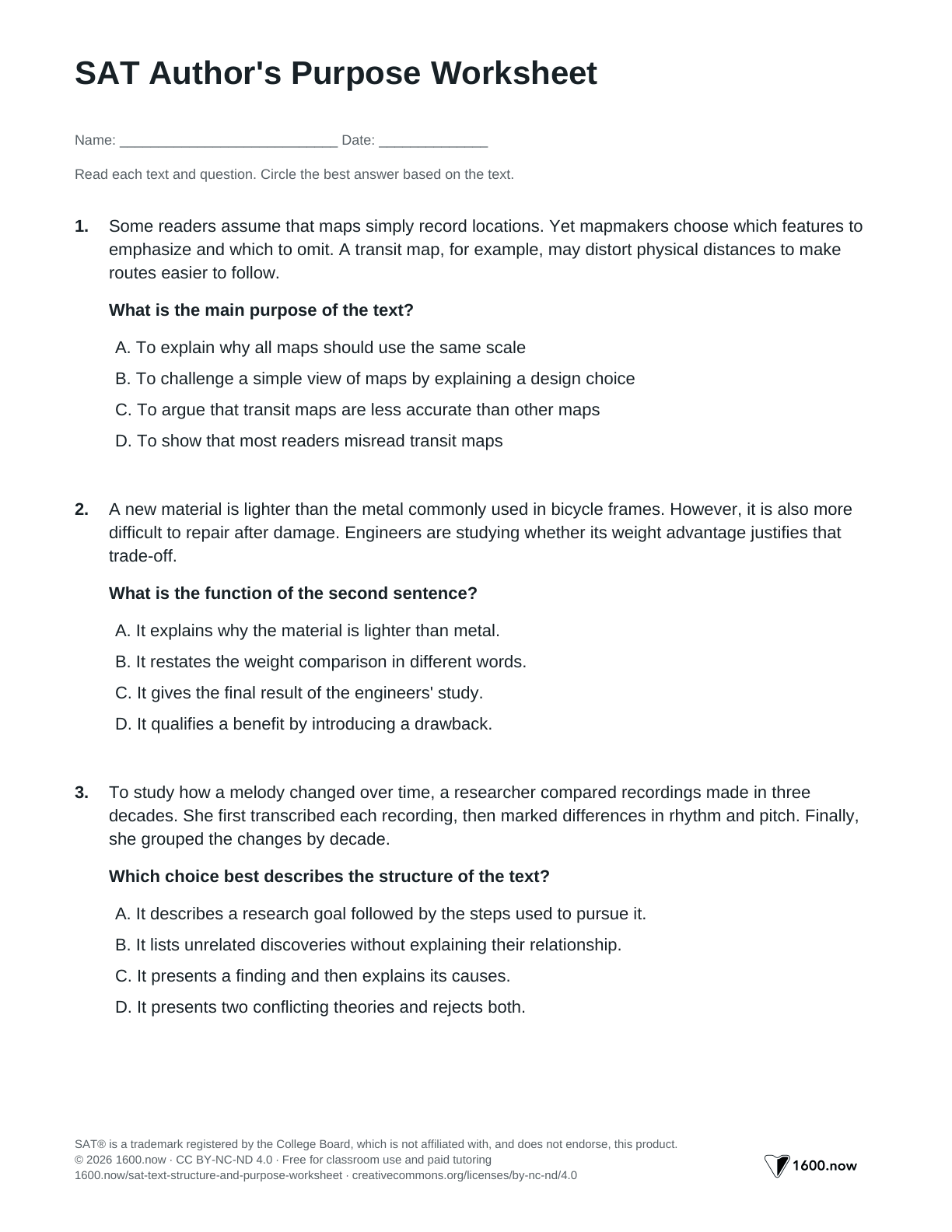
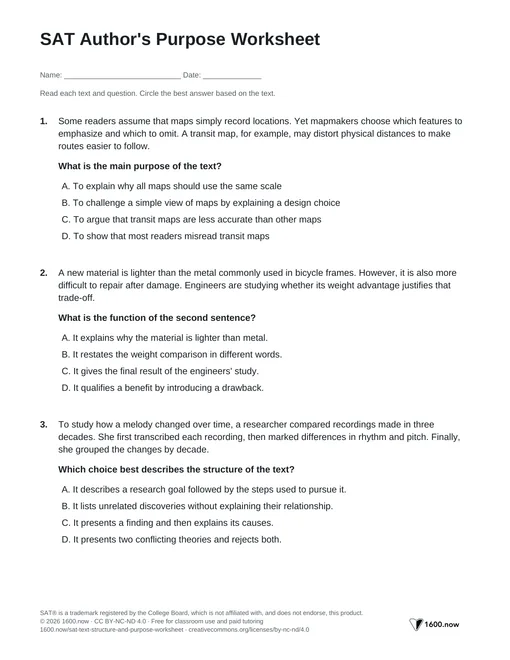
Some readers assume that maps simply record locations. Yet mapmakers choose which features to emphasize and which to omit. A transit map, for example, may distort physical distances to make routes easier to follow.
What is the main purpose of the text?
B. The text challenges the idea that maps only record locations, using a transit map as an example of a deliberate design choice. It doesn't rank transit maps against other maps or say that readers misread them.
Question 2
A new material is lighter than the metal commonly used in bicycle frames. However, it is also more difficult to repair after damage. Engineers are studying whether its weight advantage justifies that trade-off.
What is the function of the second sentence?
D. Harder repairs limit the appeal of the lighter weight, so the sentence adds a drawback. It doesn't explain the weight, repeat it, or report what the engineers decided.
Question 3
To study how a melody changed over time, a researcher compared recordings made in three decades. She first transcribed each recording, then marked differences in rhythm and pitch. Finally, she grouped the changes by decade.
Which choice best describes the structure of the text?
A. The opening gives the research goal; the remaining sentences outline transcription, comparison, and grouping. Those steps all serve the same investigation.
Question 4
Urban trees can affect the experience of walking through a neighborhood. Their shade can reduce direct sun exposure, and their branches can create a sense of enclosure along a street. These effects help explain why planners consider trees when designing pedestrian spaces.
What is the main purpose of the text?
C. The text links the effects of trees to how planners design pedestrian spaces. It doesn't recommend trees for every street, compare species, or rank cities.
Question 5
One team dates a building by examining its timber. Another compares the building's decorative details with those of dated structures nearby. Using both approaches can help researchers evaluate whether the evidence points to the same period.
Which choice best describes the organization of the text?
B. The text introduces two ways to date a building, by its timber and by its decorative details, then says using both lets researchers check whether they agree. It never ranks the methods or gives a date.
Question 6
The survey found that most respondents favored extending park hours. Because respondents volunteered to participate, the result may not represent all residents. The city plans to seek additional feedback before making a decision.
What is the function of the second sentence?
A. People who volunteer for a survey may differ from other residents, so the sentence limits how far the result applies. It doesn't reverse or explain the result, and the city hasn't decided yet.
Question 7
A city once measured a park's success mainly by its visitor count. Its current evaluation also considers accessibility, maintenance, and the range of activities available. These additional measures offer information that attendance alone cannot provide.
What is the main purpose of the text?
C. The text moves from visitor counts alone to several measures. It says attendance can't show everything, not that counts are useless, and it reports no change in the parks themselves.
Question 8
The new paint dries quickly, which can shorten construction schedules. However, it must be applied within a narrow temperature range. Contractors therefore need to consider local weather when choosing it.
What is the function of the second sentence?
D. The temperature range limits when the paint can be used, which qualifies the benefit in the first sentence. Contractors come up only in the third sentence.
Question 9
To investigate a change in a river's course, researchers compared maps from three periods. They then checked the mapped positions against sediment layers found along the former channel.
Which choice best describes the organization of the text?
A. The first sentence gives the goal and the map comparison. The second uses sediment layers to check the mapped positions, so the methods work together and nothing is disproved.
Question 10
The phrase "silent film" can be misleading. Many films from that period were shown with live music, and some screenings included spoken commentary. The absence of a recorded soundtrack did not necessarily mean an audience heard nothing.
What is the main purpose of the text?
B. Live music and spoken commentary show why the label silent can mislead. Those examples support the point about the label; the text doesn't explain how the music was performed or propose a new name.
Question 11
A historian located an unsigned letter among a merchant's papers. Its handwriting resembles the merchant's, but handwriting alone cannot establish authorship. The historian is now comparing the letter's references with dated entries in the merchant's diary.
What is the function of the second sentence?
C. The handwriting is a clue, but the sentence says it can't settle who wrote the letter. That limit leads to the diary comparison in the next sentence.
Question 12
Some researchers examine individual words to study a writer's style. Others measure sentence length or patterns of punctuation. Together, these methods reveal features at several scales of a text.
Which choice best describes the structure of the text?
D. Word-level and sentence-level methods are described first. The final sentence explains what their combination can reveal.
0/12 correct
Check your author's purpose answers
Each row is a wrong answer choice from one of the sheet's problems, with the job the passage actually gives the sentence or the text.
| What your answer looked like | What actually happened | Fix it next time |
|---|---|---|
| “Two approaches are compared, and one is shown to be more reliable” in problem 5 | The passage never ranks the timber method against the decorative-details method. Its last sentence says using both lets researchers check whether the evidence points to the same period. | Before choosing an answer with a winner, find the sentence that names the winner. Here there isn't one: two approaches, then a reason to use them together. |
| “It explains why most respondents favored longer hours” in problem 6 | The second sentence is about who answered the survey, not why they wanted longer hours. People who volunteer may differ from other residents. | Ask what the sentence does to the result before it. Here it narrows how far the result applies, so it identifies a limitation of the survey evidence. |
| “To argue that visitor counts are useless for evaluating parks” in problem 7 | The passage says attendance alone can't provide some information. Useless goes much further. The city's current evaluation “also considers” other measures, so it still counts visitors. | Match the strength of the author's claim. The city added measures to the visitor count, so the purpose is to describe a broader approach to evaluating parks. |
| “It explains how contractors choose among paints” in problem 8 | Contractors come up only in the third sentence. The second sentence says the paint must be applied within a narrow temperature range, which limits when it can be used. | Cover the other sentences and label only the one the question names. A benefit followed by however and a limit is a constraint on using the paint. Problem 2 has the same shape: lighter weight, then harder repairs. |
| “To explain how live music was performed during screenings” in problem 10 | Live music is the example. The passage never says how the music was played; it uses the music to show why the label silent film can mislead. | Ask what the example is there to prove. The first sentence says the phrase can be misleading and the rest supports that, so the purpose is to clarify a limitation of a common label. |
| “It establishes that the merchant wrote the letter” in problem 11 | The sentence says the opposite. The handwriting resembles the merchant's, “but handwriting alone cannot establish authorship.” | Read past the word but. The sentence gives a clue and then limits it, which is why the historian goes on to check the letter against the merchant's diary. |
Worked example: labeling each sentence's job
Problem 3 asks for the structure of a three-sentence passage about a melody. Label each sentence before you look at the choices. The first gives the goal: to study how the melody changed, the researcher compared recordings from three decades. The second and third give steps, marked by first, then, and finally: transcribe each recording, mark differences in rhythm and pitch, and group the changes by decade. Your labels read goal, step, step.
Now match the labels to the choices. A research goal followed by the steps used to pursue it fits all three sentences. “It presents a finding and then explains its causes” needs a finding, and the passage never says what changed. The passage also reports no discoveries and names no theories, which rules out the other two choices.
Apply the check to fresh questions
For another purpose question, write sentence-job labels before viewing the answers. Use the practice link to test whether the chosen description matches the whole structure.
Review the text structure and purpose method