
SAT Systems of Equations Worksheet
A solution to a system must satisfy both equations. Use substitution when a variable is already isolated, or elimination when adding scaled equations removes a variable. Check whether the requested expression can be found directly.

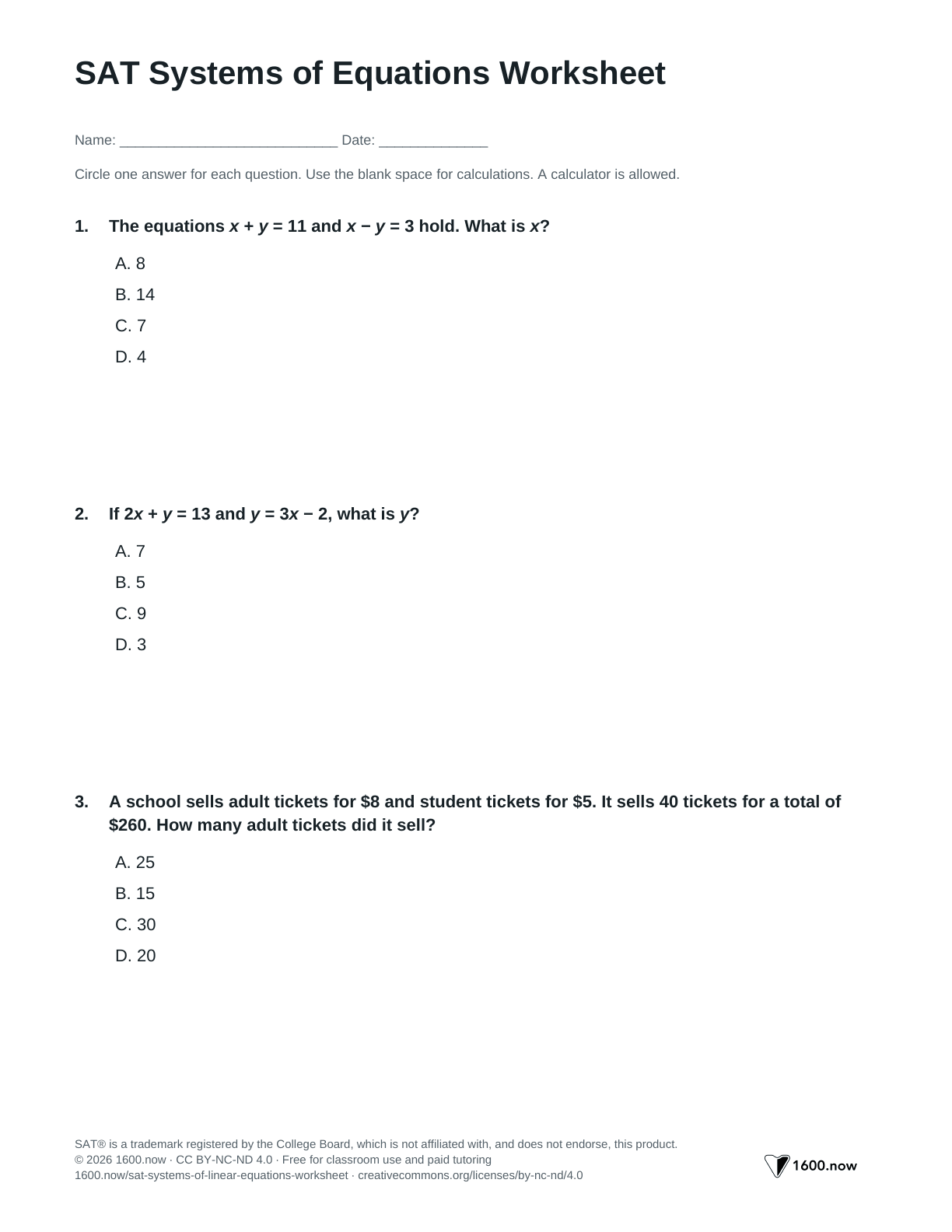
The 12 questions include substitution, elimination, parameters, and systems with zero or infinitely many solutions. Letter and A4 downloads include student and explained answer-key versions.
12 questions · about 25 minutes · Algebra › Systems of two linear equations in two variables
Share to Google Classroom · This worksheet is free to print and share under CC BY-NC-ND 4.0. Tutors may also use it in paid sessions. If you post it online, please link to this page instead of re-uploading the PDF. These are original questions, not College Board items.
Choose the operation that gives the requested value
If and , adding gives , so . Substitute into either equation for , then check the other. If the question asks only for a combination such as , you may already have what you need.
When multiplying an equation for elimination, multiply every term, including the constant. Subtract whole equations with parentheses so the second equation’s negative terms change sign correctly.
If elimination removes both variables, inspect what remains. A false statement such as means no solution; an identity such as means the equations describe the same line. Distinct nonparallel lines have one intersection.
Try it yourself
Choose an answer.
Questions
Question 1
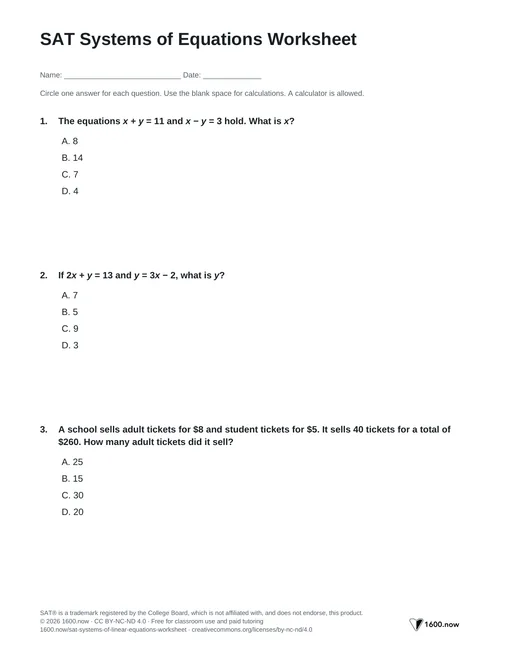
The equations and hold. What is ?
C. Add the equations to eliminate : , so . Then .
Question 2
If and , what is ?
A. Substitute for : , giving . The question asks for .
Question 3
A school sells adult tickets for $8 and student tickets for $5. It sells 40 tickets for a total of $260. How many adult tickets did it sell?
D. Let be adult tickets and student tickets. From , . Then , so and .
Question 4
If and , what is ?
B. Add the equations: . Factor , so . Solving for both variables is unnecessary.
Question 5
For which value of does the system and have no solution?
D. Doubling the first equation gives . When , the second equation has the same left side but equals 20, so the equations cannot both hold.
Question 6
The equations and describe the same line. What is ?
C. Divide the first equation by 2: . The same line requires , producing infinitely many shared solutions.
Question 7
If and , what is ?
C. Subtract the second equation from the first: , so . Substitution gives .
Question 8
If and , what is ?
B. Substitute for : . Then and .
Question 9
A collection contains 18 coins, all nickels or dimes, worth $1.35 altogether. How many dimes are in the collection?
B. In cents, and . Subtract five times the first equation to get , so .
Question 10
The system and has infinitely many solutions. What is ?
A. Dividing the second equation by 3 gives . To represent the same line, the first equation must have .
Question 11
If and , what is ?
C. Adding the equations eliminates and immediately gives . Solving separately for is unnecessary.
Question 12
A system consists of and . How many solutions does it have?
A. Doubling the first equation gives , which contradicts the second equation. Parallel distinct lines have no shared solution.
0/12 correct
Check your systems answers
Each row is a wrong answer choice from one of the sheet's problems. Find the one you picked, then run the check in the last column.
| What your answer looked like | What actually happened | Fix it next time |
|---|---|---|
| 3 in problem 2 or 7 in problem 8 | You found the other variable. In problem 2, and the question asks for . In problem 8, and the question asks for . | Finish with the variable the question names: in problem 2, and in problem 8. |
| 3 or 4 in problem 4 | Those are and on their own. The question asks for . | Add the equations: , so . Problem 11 works the same way: adding gives , and 3 is , not . |
| 12 in problem 6 | You halved the left side of but not the right side. | Divide every term by 2: , so . Check with , a point on the first line: . |
| 3 in problem 10 | You copied the coefficient of from without scaling the rest. is a different line. | Divide by 3 to get . That matches only when . |
| Infinitely many in problem 12 | The left sides are multiples, but the right sides aren't. Doubling gives , and the second equation says . | Scale one equation so the left sides match, then compare the constants. The same constant means infinitely many solutions, and a different one means zero. Here , so there are zero. |
Worked example: the system with no solution
Problem 5 asks which gives the system and no solution. Double the first equation so the -terms match: . Subtract it from the second equation: .
If isn't 6, then and the system has exactly one solution. If , the left side is , and is false, so the answer is 6. The choice 3 copies the -coefficient without doubling it; with you get and a single solution.
Apply the check to fresh questions
Before solving another system, write the variable or combination the question asks for. After solving, substitute into both original equations. Continue through the systems practice link.
Review the systems of linear equations method