
SAT Ratios and Rates Worksheet
A ratio compares quantities; a rate compares quantities with different units. For a part-to-part ratio, add the parts before using a total. For a rate, keep units attached so you know whether to multiply or divide.

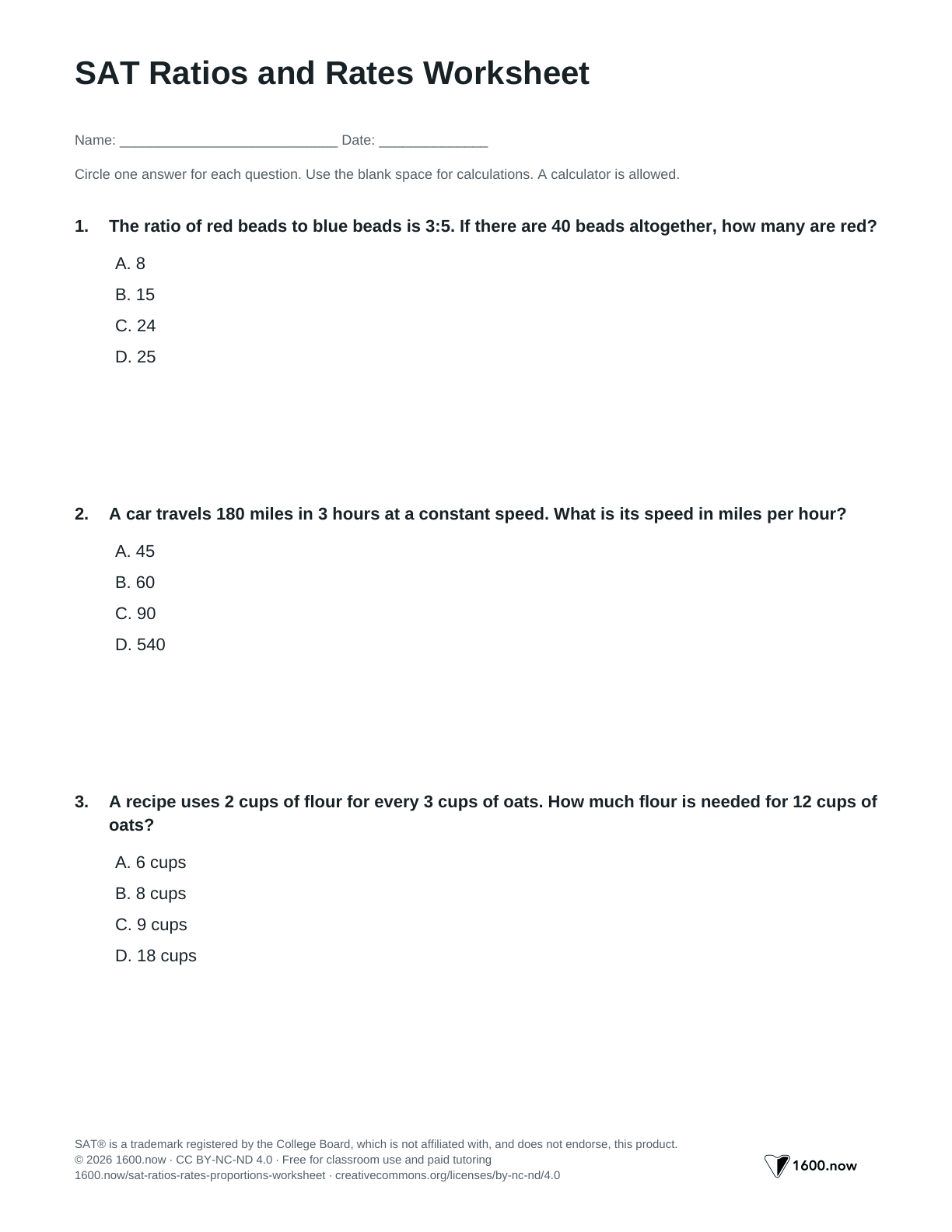
The 12 questions below include unit rates, proportions, recipes, scale factors, density, and conversions. Download the student worksheet or the PDF with explained answers.
12 questions · about 25 minutes · Problem-Solving and Data Analysis › Ratios, rates, proportional relationships, and units
Share to Google Classroom · This worksheet is free to print and share under CC BY-NC-ND 4.0. Tutors may also use it in paid sessions. If you post it online, please link to this page instead of re-uploading the PDF. These are original questions, not College Board items.
Define what each number in the ratio counts
A red-to-blue ratio of means three equal parts of red and five of blue, or eight parts overall. Red is of the total, not . Multiply both parts by the same factor to preserve the ratio.
A direct proportion has , so stays constant. Adding the same difference to both quantities can preserve a gap while breaking the ratio. Test the quotient when a table is supposed to be proportional.
For rates and conversions, arrange factors so unwanted units cancel. Miles divided by hours gives miles per hour. Grams per milliliter times milliliters gives grams. If the resulting units do not match the requested quantity, revisit the setup.
Try it yourself
Choose an answer.
Questions
Question 1
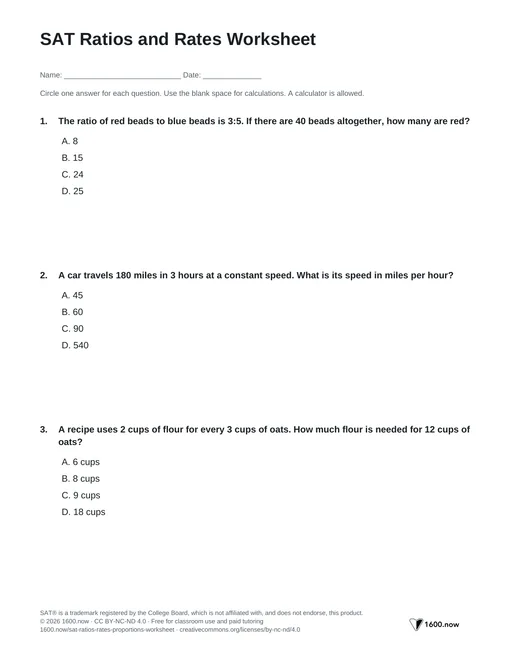
The ratio of red beads to blue beads is . If there are 40 beads altogether, how many are red?
B. There are equal parts. Each part contains beads, so red beads total .
Question 2
A car travels 180 miles in 3 hours at a constant speed. What is its speed in miles per hour?
B. Rate equals distance divided by time. Dividing 180 miles by 3 hours gives 60 miles per hour.
Question 3
A recipe uses 2 cups of flour for every 3 cups of oats. How much flour is needed for 12 cups of oats?
B. The oats are multiplied by 4, from 3 to 12. Multiply the flour by the same factor: cups.
Question 4
A map uses 1 centimeter to represent 8 kilometers. How many kilometers does a 4.5-centimeter distance represent?
C. Multiply the map distance by the scale: 4.5 centimeters times 8 kilometers per centimeter equals 36 kilometers.
Question 5
A machine produces 150 parts in 6 minutes. At the same rate, how many parts does it produce in 10 minutes?
C. The rate is parts per minute. In 10 minutes, the machine produces parts.
Question 6
How many inches are in 3.5 feet? Use 12 inches = 1 foot.
C. Multiply 3.5 feet by 12 inches per foot. The feet cancel, leaving 42 inches.
Question 7
A runner covers 400 meters in 80 seconds. What is the average speed in meters per second?
B. Divide distance by time: meters per second. The requested unit is not seconds per meter.
Question 8
If is directly proportional to and when , what is when ?
C. Direct proportion means . Here , so .
Question 9
Paint covers 240 square feet per gallon. How many gallons are needed to cover 900 square feet at this rate?
C. Divide total area by coverage per gallon: gallons. No requirement to buy whole containers is stated.
Question 10
The ratio of teachers to students is 2:35. If there are 280 students, how many teachers are there?
B. The student count is 8 times 35. Multiply the teacher part by 8 as well: .
Question 11
A liquid has density 1.2 grams per milliliter. What is the mass of 250 milliliters?
C. Mass equals density times volume. Multiplying 1.2 grams per milliliter by 250 milliliters gives 300 grams.
Question 12
A vehicle uses 4 gallons to travel 112 miles. At the same efficiency, how far can it travel on 7 gallons?
C. The efficiency is miles per gallon. Seven gallons provide miles.
0/12 correct
Check your ratios answers
Each row is a wrong answer choice from one of the sheet's problems. Find the one you picked, then run the check in the last column.
| What your answer looked like | What actually happened | Fix it next time |
|---|---|---|
| 540 in problem 2 | You multiplied 180 miles by 3 hours. That unit is mile-hours, which isn't a speed. | Miles per hour means miles divided by hours: . |
| 18 cups in problem 3 | You flipped the ratio. The recipe uses 2 cups of flour for every 3 cups of oats, so it needs less flour than oats. | 12 cups of oats is 4 times 3, so the flour is cups. |
| 22 in problem 8 | You added the gap between and : , and . Direct proportion multiplies. | with , so . Check: . |
| 8 in problem 10 | 8 is the scale factor from 35 to 280, not the number of teachers. | Scale both parts of the ratio: teachers for students. |
| 208 grams in problem 11 | You divided 250 by 1.2. Milliliters divided by grams per milliliter doesn't leave grams. | Multiply so the milliliters cancel: grams. |
Worked example: a part-to-part ratio
Problem 1 says red beads and blue beads are in the ratio 3:5, with 40 beads in all. That ratio compares red to blue, so 3 and 5 are parts of the same whole: parts make 40 beads, and each part is beads.
Red takes 3 parts, beads, and blue takes . Check: , and reduces to . The choice 24 treats red as of all 40 beads, 25 is the blue count, and 8 is the number of parts.
Apply the check to fresh questions
On your next ratio or rate question, label the units and decide whether the ratio is part-to-part or part-to-whole. Use the practice link for fresh proportions and conversions.
Review the ratios, rates, and proportions method