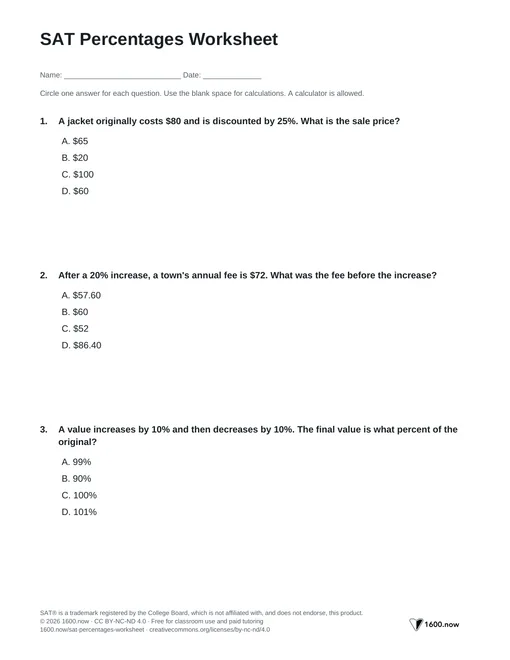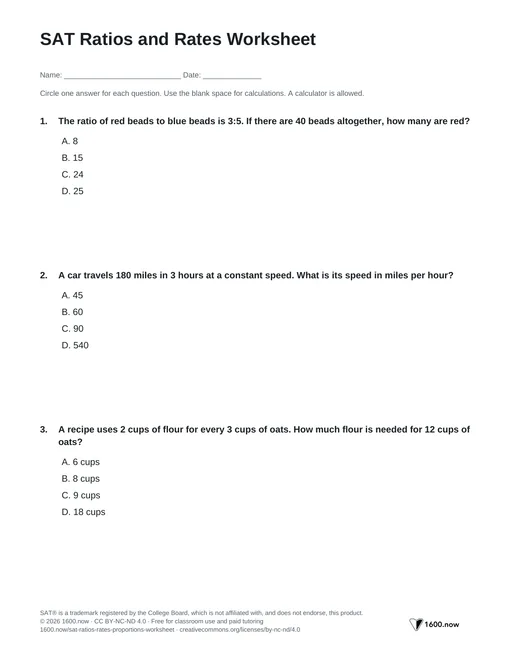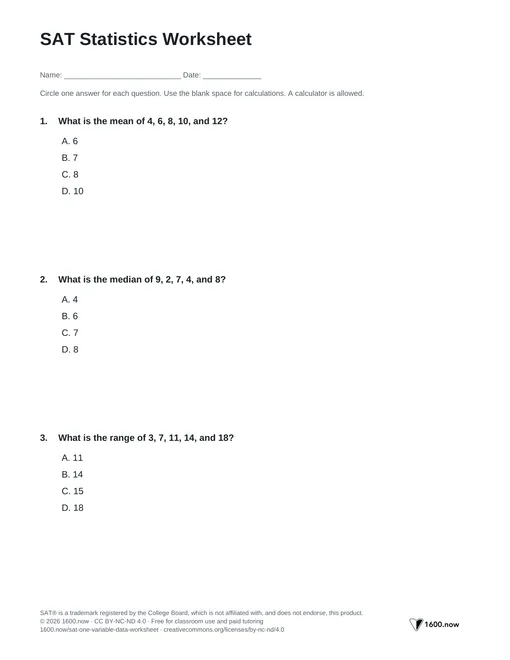

SAT Probability Worksheet
Probability is the number of favorable outcomes divided by the number of eligible outcomes. In a conditional probability question, the condition changes the eligible group before you form the fraction.

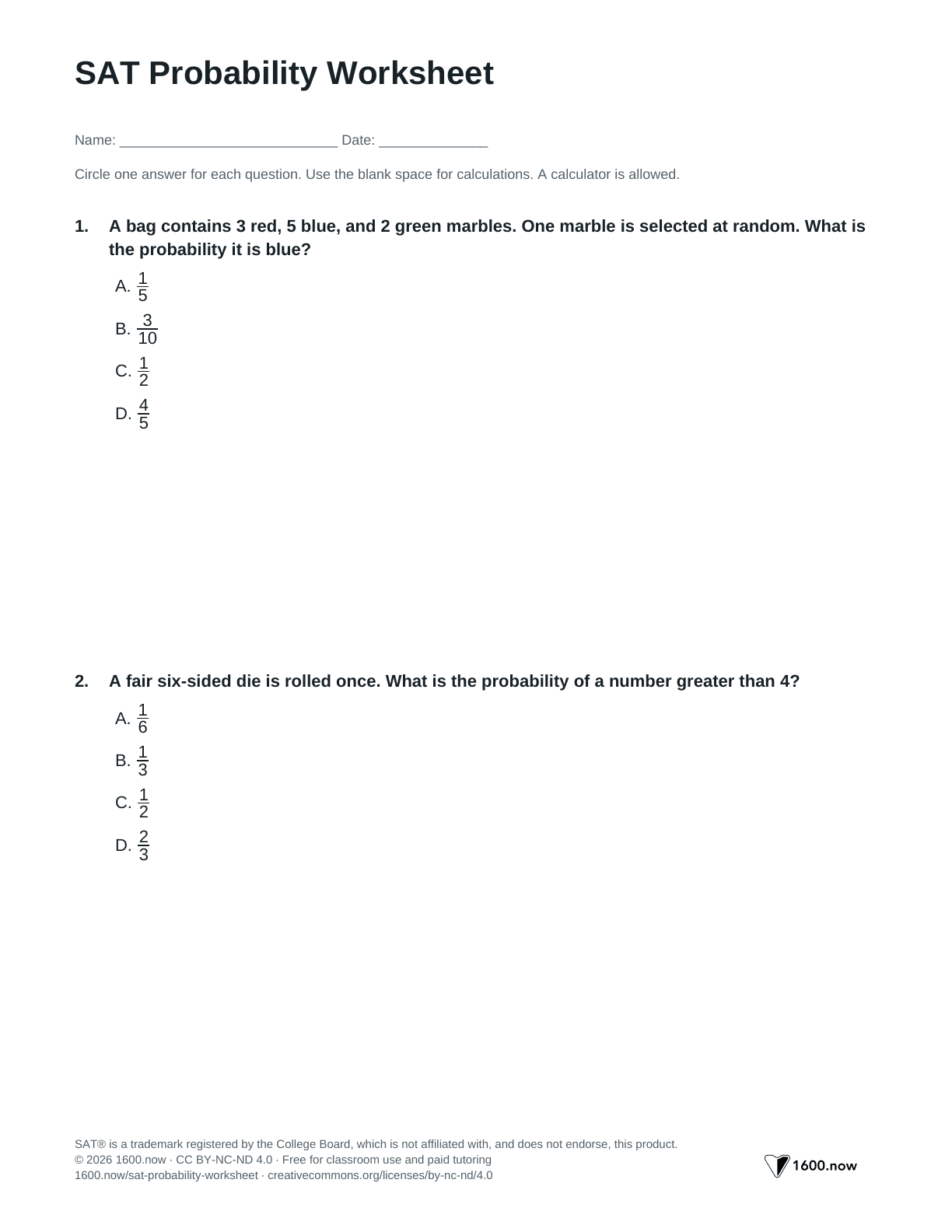
This 12-question worksheet includes two-way tables, complements, independent events, and draws without replacement. Use the questions on screen or download a Letter/A4 PDF with a separate student version and an explained answer key.
12 questions · about 25 minutes · Problem-Solving and Data Analysis › Probability and conditional probability
Share to Google Classroom · This worksheet is free to print and share under CC BY-NC-ND 4.0. Tutors may also use it in paid sessions. If you post it online, please link to this page instead of re-uploading the PDF. These are original questions, not College Board items.
Find conditional probability from a two-way table
For a table, first translate the question into a group. In problem 6, eight students play a sport and are in the band, out of 40 students overall. With no condition, the probability of both is .
If the question instead asks for band membership given that a student plays a sport, keep only the sport row. That row contains students, so the conditional probability is . The numerator stays eight; the denominator changes. If the condition were band membership, use the band column total instead.
For a complement, subtract from one. For independent events that must both happen, multiply the probabilities. Without replacement, update both the favorable count and the total after each draw: the second draw occurs from a smaller collection.
Try it yourself
Choose an answer.
Questions
Question 1
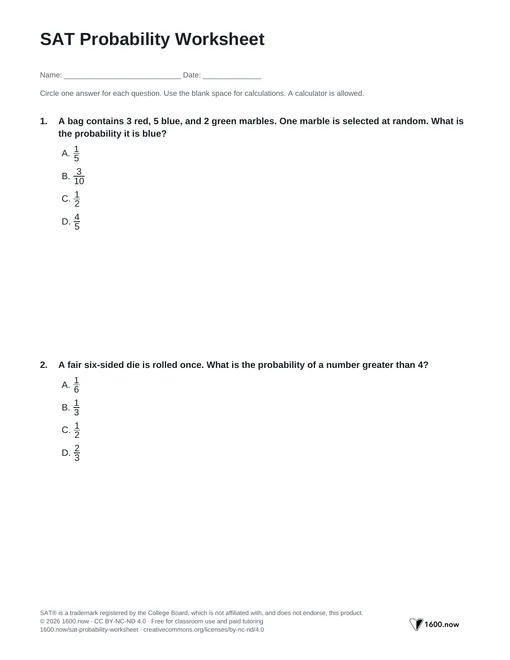
A bag contains 3 red, 5 blue, and 2 green marbles. One marble is selected at random. What is the probability it is blue?
C. There are 10 equally likely marbles, of which 5 are blue. The probability is .
Question 2
A fair six-sided die is rolled once. What is the probability of a number greater than 4?
B. The favorable results are 5 and 6, two of the six equally likely outcomes. Thus the probability is .
Question 3
Of 40 students, 18 play an instrument. If one student is chosen at random, what is the probability the student does not play an instrument?
C. There are students who do not play. The probability is .
Question 4
A fair coin is tossed twice. What is the probability of two heads?
A. The tosses are independent, so multiply by . Equivalently, HH is one of four equally likely ordered outcomes.
Question 5
Grade Bus Other travel Senior 12 8 Junior 18 22 The table shows how the students in a club travel to school. One student is chosen at random from those who ride the bus. What is the probability that the student is a senior?
C. Restrict attention to bus riders: 12 seniors and 18 juniors, for 30 total. The probability is . Choice B, , ignores the condition, and choice D, , divides by the seniors instead of the bus riders.
Question 6
Group In band Not in band Plays sport 8 12 No sport 6 14 The table shows whether each student in a class plays a sport and whether the student is in the band. If one student from the class is selected at random, what is the probability that the student both plays a sport and is in the band?
B. The intersection contains 8 students. The overall total is , giving .
Question 7
Events A and B are independent, with probabilities 0.4 and 0.3. What is the probability that both occur?
B. Independence allows multiplication: P(A and B) = .
Question 8
A box contains 4 black and 6 white tiles. Two tiles are selected at random without replacement. What is the probability both are black?
A. The first-black probability is . After a black tile is removed, the second-black probability is . Their product is .
Question 9
A fair die is rolled once. What is the probability of an even number or a 5?
C. The favorable outcomes are 2, 4, 5, and 6: four out of six equally likely outcomes. The probability is .
Question 10
A random sample of 200 parts contains 6 defective parts. Using the sample proportion, about how many defective parts would be expected in 3,000 parts?
C. The observed defect proportion is . Applying it to 3000 gives an estimate of 90 defective parts, not a guaranteed count.
Question 11
An event has probability 0.72. What is the probability that it does not occur?
B. An event and its complement have probabilities summing to 1. Subtract 0.72 from 1 to get 0.28.
Question 12
A card is selected at random from 15 cards numbered 1 through 15. Given that its number is a multiple of 3, what is the probability that it is even?
C. The condition restricts the possibilities to 3, 6, 9, 12, and 15. Two of these five values, 6 and 12, are even, giving .
0/12 correct
Check your probability answers
Each row is a wrong answer choice from one of the sheet's problems. Find the one you picked; the last column shows the check that catches it.
| What your answer looked like | What actually happened | Fix it next time |
|---|---|---|
| for a number greater than 4 on one roll of a die (problem 2) | You counted 4 as a success. Greater than 4 means 5 or 6 only; including 4 would answer “at least 4.” | List the winning outcomes before you count them. 5 and 6 are 2 of the 6 outcomes, so the probability is . |
| for a student who does not play an instrument (problem 3) | That's , the chance that the student does play. The question asks for the complement. | Count the other group first: students don't play, so the probability is . Problem 11 is the same move with decimals: . |
| for two heads in two coin tosses (problem 4) | You treated two heads, one of each, and two tails as three equally likely results. One of each happens two ways, heads then tails or tails then heads, so it's twice as likely as two heads. | Write the outcomes in order: HH, HT, TH, TT. Two heads is 1 of those 4, so the probability is . |
| for a student who plays a sport and is in the band (problem 6) | divides by the 20 students who play a sport. That answers a different question: given that a student plays a sport, how likely is band? | An “and” question with no condition uses everyone in the table: , so the probability is . Use a smaller denominator only when the question says “given that” or “from those who,” as problem 5 does. |
| 0.7 for both of two independent events happening (problem 7) | You added . Both events happening can't be more likely than either one alone, and 0.7 is larger than both. | For independent events, both means multiply: . |
| for two black tiles drawn without replacement (problem 8) | That's , as if the first tile went back in the box. After one black tile is drawn, 3 black tiles are left among 9. | Update both counts after the first draw: . |
Worked example: the conditional probability question
Problem 12 picks a card from cards numbered 1 through 15 and asks: given that the number is a multiple of 3, what is the probability that it's even? The word given shrinks the list before you count anything. The multiples of 3 are 3, 6, 9, 12, and 15, so there are 5 possible cards, not 15.
Of those 5 cards, 6 and 12 are even, so the probability is . If you got , you skipped the condition and counted all 7 even cards. If you got , you found the chance of drawing a multiple of 3 at all, . If you got , you counted the right two cards but divided by all 15, which answers a different question: even and a multiple of 3.
Apply the check to fresh questions
On the next probability question, name the denominator in words before writing any numbers. Then use the practice link for another set of two-way tables and conditional events.
Review the probability and conditional probability method