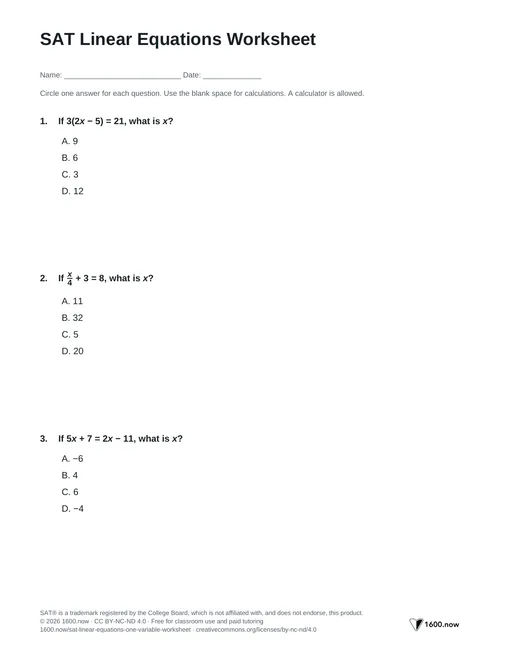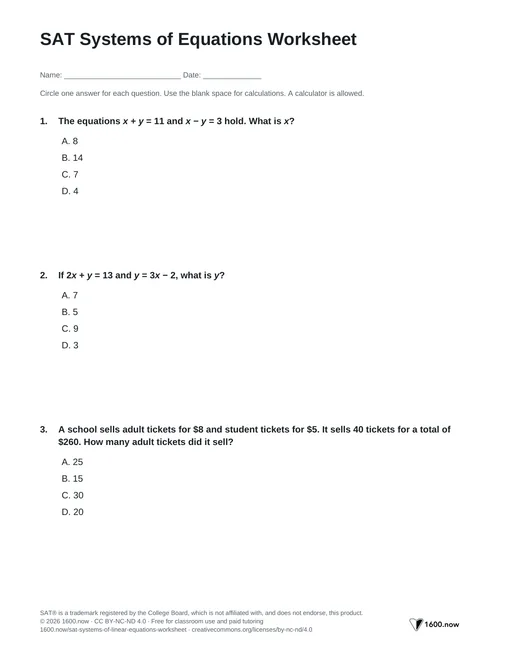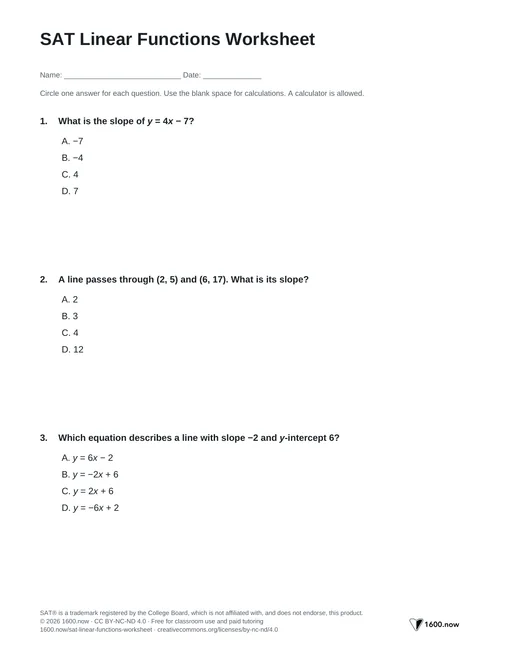

SAT Linear Equations in Two Variables Worksheet
For a line in standard form, set to find the -intercept and set to find the -intercept. To read the slope, rearrange the equation into .

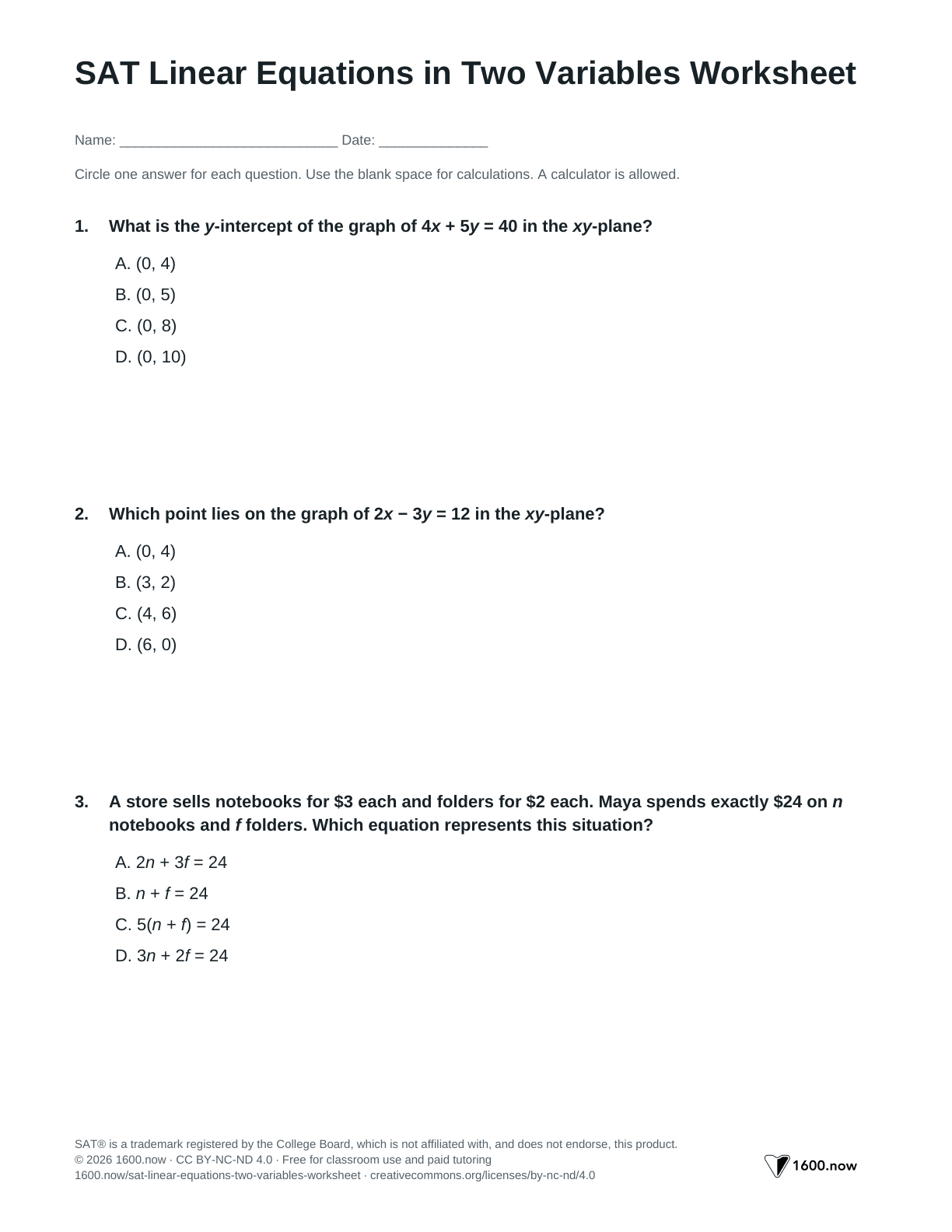
These 12 questions cover intercepts, standard form, slope, perpendicular lines, and equations from word problems. Use the printable student copy or the PDF with explained answers.
12 questions · about 25 minutes · Algebra › Linear equations in two variables
Share to Google Classroom · This worksheet is free to print and share under CC BY-NC-ND 4.0. Tutors may also use it in paid sessions. If you post it online, please link to this page instead of re-uploading the PDF. These are original questions, not College Board items.
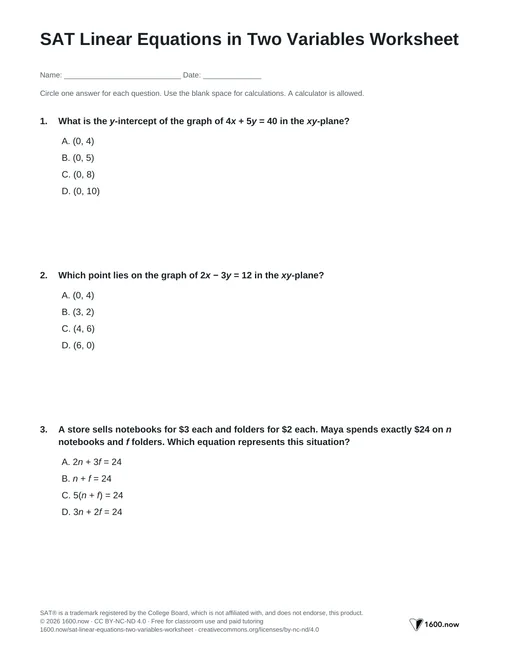
Translate between a line’s equation and its points
In , a point is a solution only if substituting both coordinates makes the equation true. Keep the order and the signs. A graph’s intercepts are points, not just the constants in the equation.
When , solving for gives . The slope is , so the coefficient of in standard form cannot be read directly as the slope. If and , the line is vertical and its slope is undefined.
For a cost equation, attach each coefficient to the correct item and include its units. Test a purchase that should fit the budget. For perpendicular nonvertical lines, the slopes multiply to ; horizontal and vertical lines are the separate perpendicular case.
Try it yourself
Choose an answer.
Questions
Question 1
What is the -intercept of the graph of in the -plane?
C. The -intercept is where . Then , so . The point is the -intercept.
Question 2
Which point lies on the graph of in the -plane?
D. Substitute each point. For , . The point gives because the -term is subtracted; the -intercept is .
Question 3
A store sells notebooks for $3 each and folders for $2 each. Maya spends exactly $24 on notebooks and folders. Which equation represents this situation?
D. The notebooks cost dollars and the folders cost dollars. Together they cost 24 dollars, so . Choice A attaches each price to the wrong item.
Question 4
Jaya earned $600 last month from hours of tutoring at $15 per hour and hours at a bookstore at $10 per hour, so . If she tutored for 20 hours, how many hours did she work at the bookstore?
B. Substitute : , so and . Choice D, 60, is the number of bookstore hours if she had not tutored at all.
Question 5
What is the slope of the graph of in the -plane?
A. Solve for : , so . The slope is the coefficient of , which is −3.
Question 6
Which equation represents the line shown in the -plane?
A. The line passes through (0, 6) and (4, 0). Both points satisfy : and . Choice B has the intercepts reversed.
Question 7
A theater models its ticket sales for one show with , where is the number of $20 tickets sold and is the number of $50 tickets sold. What is the best interpretation of the -intercept of the graph of this equation in the -plane?
C. At the -intercept, , so and . That means 50 of the $20 tickets and none of the $50 tickets. Choice B describes the -intercept, (0, 20).
Question 8
In the -plane, the graph of passes through the point (2, 6), where is a constant. What is the value of ?
A. Substitute and : . Then , so . Choice B comes from swapping the coordinates.
Question 9
0 7 2 3 5 −3 The table shows three points on a line in the -plane. Which equation represents the line?
D. When increases by 2, decreases by 4, so the slope is −2 and the line is . Adding to both sides gives . Choice C passes through (0, 7) but has slope 2.
Question 10
Line is perpendicular to the graph of in the -plane and passes through (0, 4). Which equation represents line ?
B. Solving for gives , so its slope is 0.4. A perpendicular line has slope . With -intercept 4, line is .
Question 11
In the -plane, the graph of , where is a positive constant, has -intercept and -intercept . If , what is the value of ?
C. Setting gives , so . Since , . Setting gives , so . Choice A comes from making twice instead.
Question 12
A line in the -plane has -intercept and -intercept , where and are positive. What is the slope of the line?
B. From to , changes by and changes by . The slope is . With both intercepts positive, the line falls from left to right.
0/12 correct
Check your two-variable equation answers
Each row is a wrong answer choice from one of the sheet's problems. Find the one you picked, then run the check in the last column.
| What your answer looked like | What actually happened | Fix it next time |
|---|---|---|
| for the y-intercept of (problem 1) | 10 comes from setting , which gives the x-intercept, . | For the y-intercept, set : , so the point is . |
| in problem 2 | The minus sign got dropped. At , , not 12. | Substitute every choice with its signs. Only works: . |
| in problem 3 | Each price is attached to the wrong item. Notebooks cost 3 dollars each, so notebooks cost dollars. | Pair each price with its own variable: . Test a real purchase: 2 notebooks and 9 folders cost dollars, but gives 31. |
| 6 or 3 for the slope of (problem 5) | In standard form, the coefficient of isn't the slope. The slope is the coefficient of after you solve for . | , so and the slope is . |
| 1 in problem 8 | You swapped the coordinates and substituted and . | In , comes first: , so and . |
| or in problem 10 | A perpendicular slope takes two changes: flip the fraction and change the sign. Each of these choices makes only one. | The given line is , with slope . Flip and negate: . Check: . |
Worked example: the intercept question with a constant
Problem 11 gives with x-intercept and y-intercept , where . Start with the intercept you can find. Set : , so . Then makes .
The point is on the line, so substitute it: , which gives . Check: crosses the axes at and , and 8 is twice 4. If you got 1.5, you made twice instead: and .
Apply the check to fresh questions
For a fresh two-variable equation, find both intercepts and substitute a point to check the signs. Use the practice link below for more standard-form and word-problem questions.
Review the linear equations in two variables method