
SAT Grammar Worksheet
Find the sentence’s subject, timeline, and grammatical structure before selecting a verb or phrase. Match the verb to the subject itself, including when a descriptive phrase sits between them.

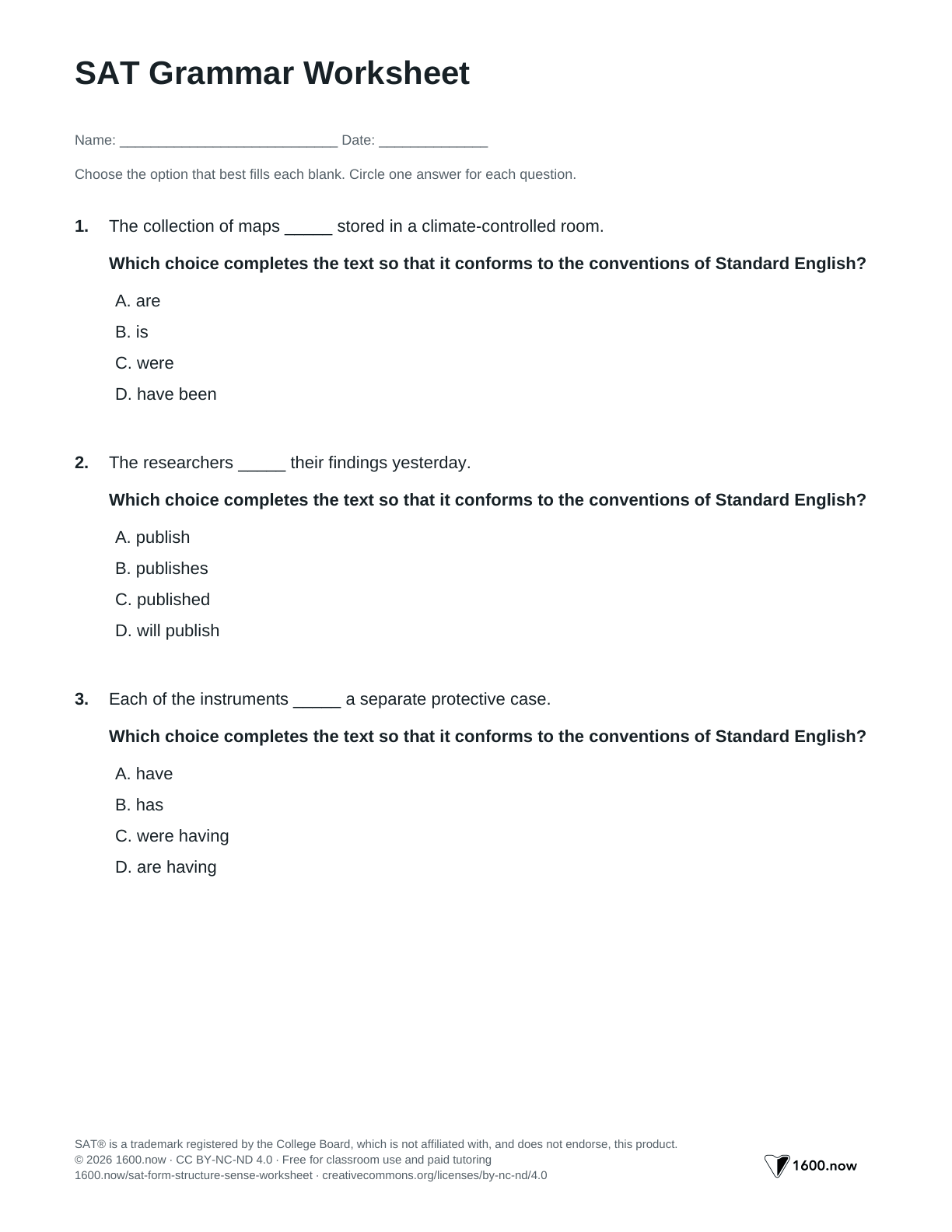
These 12 grammar questions cover agreement, tense, pronouns, modifiers, parallel structure, and comparisons. Download a student worksheet or an explained answer-key PDF in Letter or A4.
12 questions · about 25 minutes · Standard English Conventions › Form, Structure, and Sense
Share to Google Classroom · This worksheet is free to print and share under CC BY-NC-ND 4.0. Tutors may also use it in paid sessions. If you post it online, please link to this page instead of re-uploading the PDF. These are original questions, not College Board items.
Reduce the sentence to its grammatical frame
Remove an intervening phrase temporarily. "The collection of maps" has collection as its head noun, so the singular verb is fits. "Of maps" describes the collection and does not make the subject plural.
For tense, arrange the actions on a timeline. An action completed before another past action may require had plus the participle. Choose a tense from the passage’s timeline rather than from the nearest word.
An opening modifier must describe the subject immediately after it. In a list, keep the items in matching forms. In a comparison, compare the same kinds of things: a telescope to another telescope, not to the building that houses it.
Try it yourself
Choose an answer.
Questions
Question 1
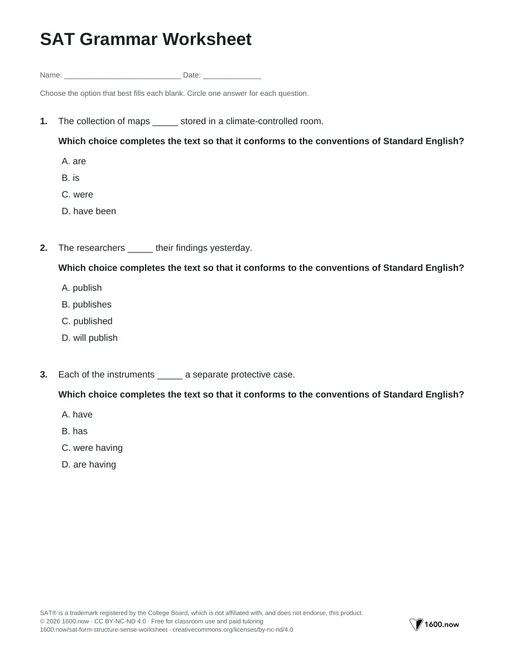
The collection of maps _____ stored in a climate-controlled room.
Which choice completes the text so that it conforms to the conventions of Standard English?
B. The singular subject is collection, not maps. The singular verb is agrees with collection; the plural alternatives do not.
Question 2
The researchers _____ their findings yesterday.
Which choice completes the text so that it conforms to the conventions of Standard English?
C. Yesterday places the completed action in the past. The past-tense verb published matches that explicit time reference.
Question 3
Each of the instruments _____ a separate protective case.
Which choice completes the text so that it conforms to the conventions of Standard English?
B. Each is singular even when followed by of the instruments. The singular verb has agrees with that subject.
Question 4
By the time the guests arrived, the chef _____ the meal.
Which choice completes the text so that it conforms to the conventions of Standard English?
C. The preparation was completed before another past action, the guests' arrival. Past perfect had prepared expresses that sequence.
Question 5
The artists displayed _____ newest paintings in the gallery.
Which choice completes the text so that it conforms to the conventions of Standard English?
A. Their is the possessive form referring to the plural artists. There marks a place, they're means they are, and its is singular.
Question 6
The samples from the river _____ traces of a mineral.
Which choice completes the text so that it conforms to the conventions of Standard English?
B. The plural subject samples requires the plural verb contain. The phrase from the river does not change the subject's number.
Question 7
Walking through the archive, _____.
Which choice completes the text so that it conforms to the conventions of Standard English?
B. The introductory phrase describes the person walking, so Lena must be the subject that immediately follows it. The other choices make labels or there the subject.
Question 8
The workshop teaches students to measure accurately, to record observations, and _____.
Which choice completes the text so that it conforms to the conventions of Standard English?
C. The list uses parallel infinitives: to measure, to record, and to analyze. The other choices change grammatical form.
Question 9
Neither the director nor the assistants _____ available for interviews today.
Which choice completes the text so that it conforms to the conventions of Standard English?
C. With neither/nor, the verb agrees with the nearer subject, assistants, which is plural. Are is the plural choice that fits today.
Question 10
The bridge, along with the two nearby tunnels, _____ inspected every spring.
Which choice completes the text so that it conforms to the conventions of Standard English?
D. The main subject is the singular bridge. The parenthetical phrase does not make it plural, so is is required.
Question 11
The larger observatory's telescope is more powerful than _____.
Which choice completes the text so that it conforms to the conventions of Standard English?
B. The comparison has to be between two telescopes. That of the smaller observatory means the smaller observatory's telescope. Choice A compares a telescope with an observatory, and those is plural.
Question 12
Because the reports were incomplete, the committee returned _____ for revision.
Which choice completes the text so that it conforms to the conventions of Standard English?
B. Them is the plural object pronoun referring to reports. It and its are singular, while theirs is possessive rather than the needed object.
0/12 correct
Check your grammar answers
Each row is a wrong answer choice from one of the sheet's problems, shown in its sentence, with the check that catches it.
| What your answer looked like | What actually happened | Fix it next time |
|---|---|---|
| “The collection of maps are stored in a climate-controlled room” in problem 1 | The plural verb are agrees with maps, the noun right before the blank. The subject is collection, which is singular; “of maps” only describes it. | Cross out the phrase between the subject and the verb and read what's left: “The collection is stored.” The same check settles problems 3, 6, and 10. |
| “By the time the guests arrived, the chef has prepared the meal” in problem 4 | The verb has prepared links a past action to the present, but this whole sentence is in the past. The cooking finished before the guests arrived. | When one past action finishes before another, use had: “By the time the guests arrived, the chef had prepared the meal.” |
| “Walking through the archive, the faded labels caught Lena's attention” in problem 7 | An opening phrase like “Walking through the archive” describes whatever comes right after the comma. Here that's the labels, and labels don't walk. | Ask who is walking and put that person right after the comma: “Walking through the archive, Lena noticed the faded labels.” |
| “The workshop teaches students to measure accurately, to record observations, and analyzing results” in problem 8 | The list starts with two items in the to form: to measure and to record. The last item, analyzing results, switches to a different form. | Give the last item the same form as the first two: to measure, to record, and to analyze. |
| “Neither the director nor the assistants is available for interviews today” in problem 9 | With neither and nor, the verb agrees with the subject closer to it. That's assistants, which is plural. | Read the nearer subject with the verb on its own: “the assistants are available.” |
| “The larger observatory's telescope is more powerful than the smaller observatory” in problem 11 | This compares a telescope with an observatory. The sentence has to compare two telescopes. | Use that of for one thing and those of for more than one: “more powerful than that of the smaller observatory” means more powerful than the smaller observatory's telescope. |
Worked example: a phrase between the subject and the verb
Problem 10 reads: “The bridge, along with the two nearby tunnels, _____ inspected every spring.” The sentence names three structures, so are can sound right. Find the subject first. The phrase along with adds information without making the subject plural. The subject is bridge, and it's singular.
Read the sentence with the phrase between the commas removed: “The bridge _____ inspected every spring.” The singular verb is fits. Are, were, and have been all need a plural subject. If the sentence said “The bridge and the two nearby tunnels,” the answer would be are.
Apply the check to fresh questions
For the next grammar question, read the stripped-down sentence first, then restore the descriptive words. Use the Form, Structure, and Sense practice link for another set.
Review the form, structure, and sense method