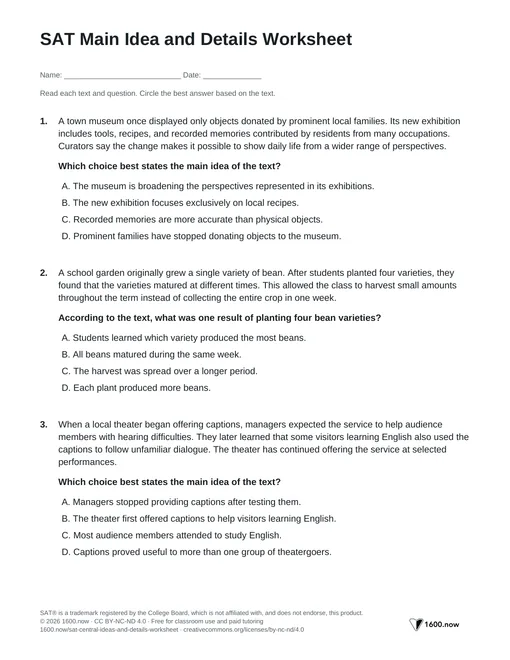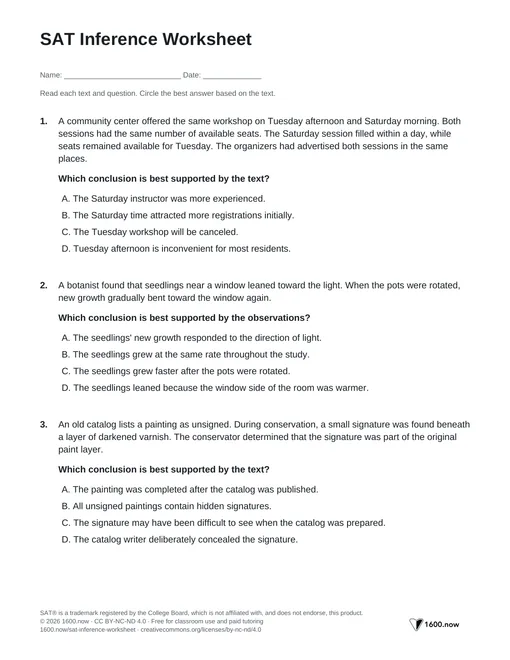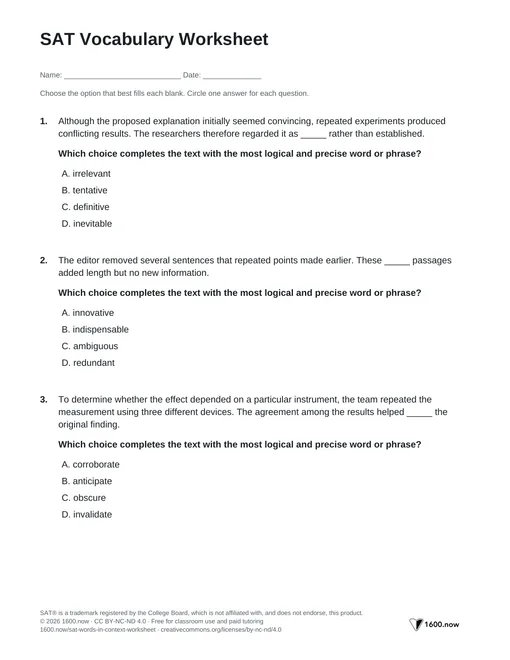

SAT Evidence Worksheet
Command of Evidence questions ask you to connect a claim to the finding, quotation, or numerical comparison that supports it or challenges it. Evidence must address the claim’s exact prediction, not merely the same topic.

This worksheet has 12 textual and quantitative evidence questions, including a weaken question and data tables. Use the questions below or print the student copy; the full PDF includes explained answers.
12 questions · about 25 minutes · Information and Ideas › Command of Evidence
Share to Google Classroom · This worksheet is free to print and share under CC BY-NC-ND 4.0. Tutors may also use it in paid sessions. If you post it online, please link to this page instead of re-uploading the PDF. These are original questions, not College Board items.
Write the prediction before choosing evidence
Reduce the claim to a testable relationship. If evening opening hours increase visits by daytime workers, supporting evidence needs visits by those workers before and after the change. Enjoying museums or staying longer measures something else.
For a quotation, identify every part of the interpretation. A character who says she dislikes attention but seeks recognition needs evidence of both the stated reluctance and the contrary behavior. A quotation proving only one half does not complete the argument.
For a table, calculate the comparison the claim names. An increase is after minus before; a rate is the count divided by the relevant total. If two groups rise from 12 to 17 and from 13 to 18, both gain even though their final scores differ.
For a weaken question, look for a competing explanation, a reversed prediction, or evidence that breaks the proposed link. A second change occurring at the same time can challenge a claim that the first change alone caused the result.
Try it yourself
Choose an answer.
Questions
Question 1
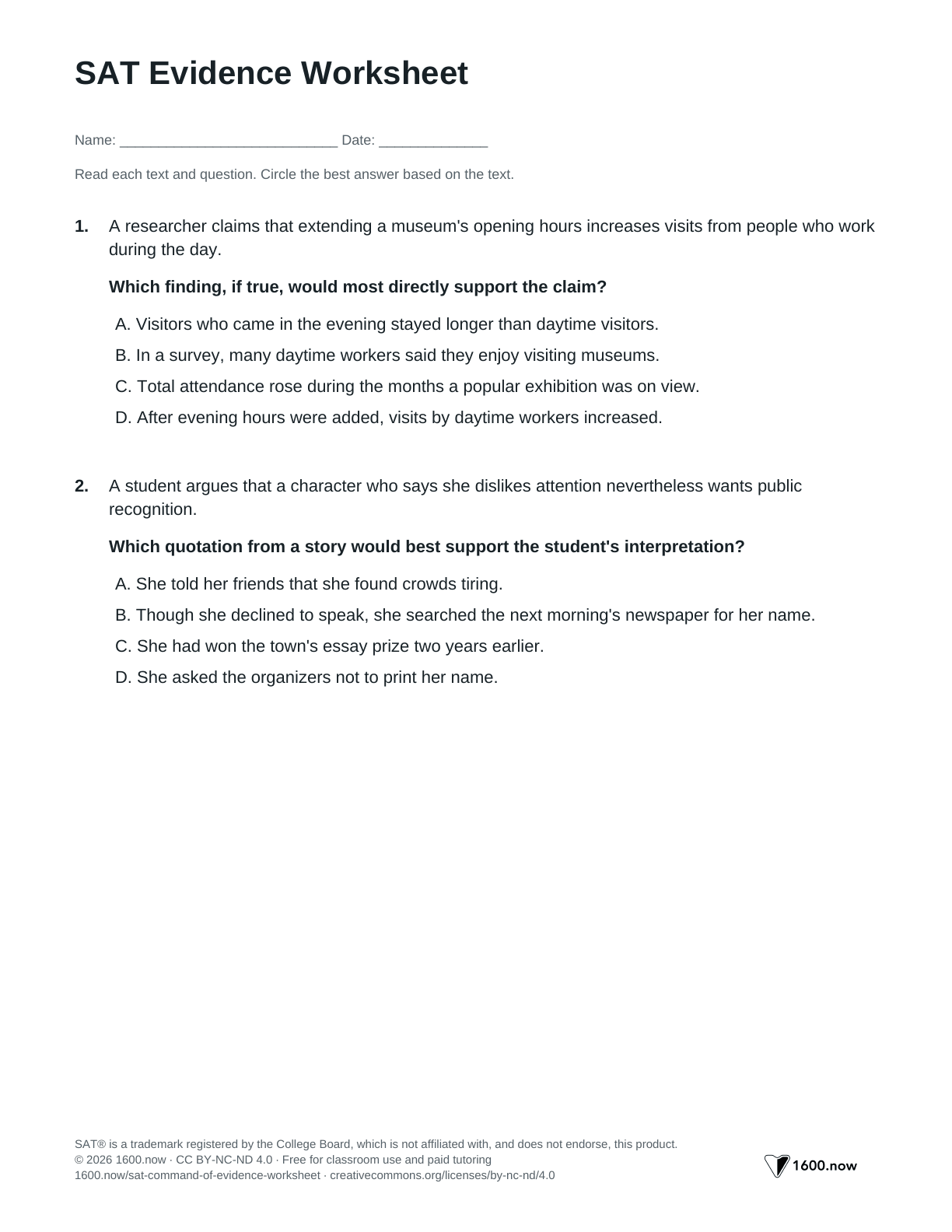
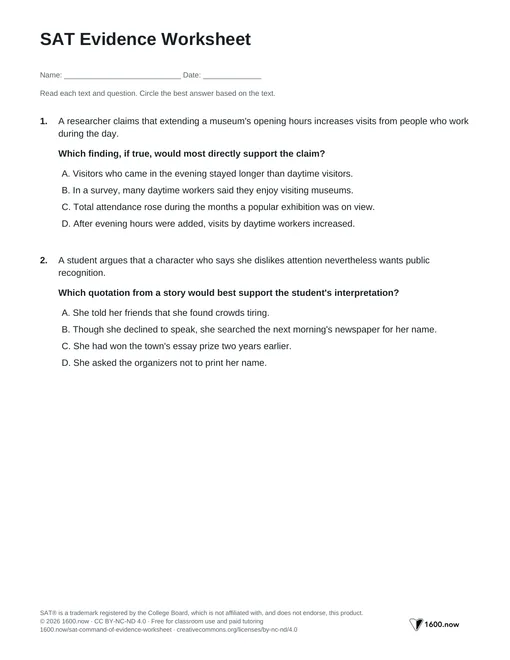
A researcher claims that extending a museum's opening hours increases visits from people who work during the day.
Which finding, if true, would most directly support the claim?
D. The claim predicts more visits from daytime workers once the hours are extended, and only choice D reports that. Enjoying museums or staying longer is not visiting more, and a popular exhibition is a different reason for higher attendance.
Question 2
A student argues that a character who says she dislikes attention nevertheless wants public recognition.
Which quotation from a story would best support the student's interpretation?
B. She declined to speak but then looked for her name in the paper, which shows she wants recognition despite what she says. Choices A and D show only the dislike of attention she claims, and an earlier prize says nothing about what she wants.
Question 3
In a classroom trial, students used either paper flashcards or a vocabulary app for the same amount of time. The table shows average quiz scores before and after practice. A teacher claims that the two groups had the same average score increase.
Practice method Before (points) After (points) Paper flashcards 12 17 Vocabulary app 13 18 Which statement best supports the claim?
A. Subtracting before from after gives and . Final scores alone do not establish equal gains.
Question 4
A planner suggests that adding bicycle racks alone caused a rise in cycling to school.
Which finding would most directly weaken that explanation?
C. The new lane is another possible cause of the increase, so the racks may not deserve all the credit. Full racks and students' praise for them fit the planner's view, and the racks' location says nothing about cause.
Question 5
A team recorded seed germination in two equally sized groups. The team claims that a larger proportion of seeds germinated in Group A.
Group Seeds planted Seeds germinated A 20 15 B 20 10 Which statement accurately uses the data to support the claim?
B. , while . Equal initial group sizes make the comparison straightforward. The choices using 15% or unequal group sizes misread the counts.
Question 6
An archivist argues that a handwritten notebook was used by several people rather than a single writer.
Which observation would most directly support the argument?
D. Distinct handwriting tied to different signed names points to several writers. One person could have kept the notebook for twenty years, lived in a large household, or written shopping lists.
Question 7
A biologist predicts that a particular seed sprouts more often after exposure to light than when kept in darkness. Two groups receive the same water and temperature.
Which result would most directly support the prediction?
C. The prediction is about how often the seeds sprout, and a higher germination rate in light matches it. Sprouting sooner or growing taller is a different result, and seeds from the same plant are a control.
Question 8
A student argues that a story's narrator admires a rival despite claiming to dislike her.
Which quotation would best support the interpretation?
D. Keeping every review that praised her remarkable work shows admiration under the irritation. Criticizing her or wanting to beat her shows only rivalry, and the judges' praise is not the narrator's.
Question 9
A researcher claims that an increase in recorded bicycle trips reflects a new tracking app rather than an increase in cycling itself.
Which finding would most directly support that explanation?
A. A roadside counter that doesn't depend on the app saw steady traffic, so the rise in app records likely came from better recording. Rising bicycle sales would point toward more cycling.
Question 10
A teacher claims that students in a practice group improved more than those in a comparison group. Mean scores increased from 50 to 68 in the practice group and from 52 to 61 in the comparison group.
Which statement uses the data to support the claim?
B. The relevant comparison is the change: and . Starting or final scores alone do not measure improvement.
Question 11
An archaeologist argues that a room was used for weaving rather than for storing grain.
Which discovery would most directly support the argument?
C. Loom weights and textile fibers on the floor point to weaving in this room. Grains fit storage instead, and room size or regional habits don't show what this room was used for.
Question 12
A researcher grew plants of two varieties under identical conditions, except that half the plants of each variety received a fertilizer. She concludes that the two varieties respond differently to the fertilizer.
Which result most directly supports the conclusion?
D. Choice D shows the fertilizer changed one variety and not the other. Choice A says both varieties grew taller with it, which doesn't show a difference between them. Planting dates and fertilizer source are controls, not results.
0/12 correct
Check your evidence answers
Each row is a wrong answer choice from one of the sheet's problems, with what the claim actually needed.
| What your answer looked like | What actually happened | Fix it next time |
|---|---|---|
| “In a survey, many daytime workers said they enjoy visiting museums” in problem 1 | It's about daytime workers and museums, but the claim predicts a change: more visits once the hours are extended. Enjoying museums says nothing about whether they came more often. | Put the prediction in your own words first: after evening hours start, daytime workers visit more. Only the finding that their visits rose after evening hours were added tests it. |
| “She asked the organizers not to print her name” in problem 2 | This shows only the half of the claim the character says out loud, that she dislikes attention. The student's reading is that she wants recognition anyway. | A claim with two parts needs a quotation that shows both. She declined to speak, then searched the next morning's newspaper for her name. Problem 8 works the same way: irritation on the surface, admiration underneath. |
| “The app group had a higher final score” in problem 3 | True, 18 to 17, but the claim is about the increase. Two groups can finish at different scores and still gain the same amount. | Subtract before from after for each group: and , so both improved by 5 points. Problem 10 is the same move: against . |
| “Group A had a germination rate of 15%” in problem 5 | 15 is the number of Group A seeds that germinated. A rate divides that count by the 20 seeds planted. | Divide before you compare: 15 of 20 is 75% for Group A, and 10 of 20 is 50% for Group B. |
| “Seeds in the light-exposed group sprouted a day earlier on average” in problem 7 | The prediction is about how often the seeds sprout. Sprouting sooner is a different measurement; seeds in light could sprout earlier and still sprout at the same rate. | Circle the measurement in the claim, here how often seeds sprout, and pick the choice that reports it: a higher germination rate in the light-exposed group. |
| “Bicycle sales at local shops rose during the same period” in problem 9 | More bicycle sales point toward more cycling, which is the explanation the researcher is arguing against. | Ask which way a finding pushes before you pick it. The researcher needs cycling to stay flat while app records rise, and a roadside counter that doesn't depend on the app recorded about the same traffic before and after the launch. |
| “Fertilized plants of both varieties grew taller than unfertilized plants” in problem 12 | Both varieties grew taller with fertilizer, and nothing in that result sets one apart from the other. It supports a claim about the fertilizer, not a difference between varieties. | A claim that two groups differ needs a result that differs: fertilizer made Variety A taller but not Variety B. |
Worked example: the weaken question
Problem 4 says a planner credits new bicycle racks alone for a rise in cycling to school, and asks which finding would most directly weaken that explanation. The word alone is the one to attack. A finding that weakens it has to show another cause arriving at the same time as the racks.
Racks full on weekday mornings and students saying the racks made locking easier both fit the planner's view, so neither can weaken it. The racks' spot near the main entrance says nothing about cause. That leaves the protected bicycle lane that opened at the same time and connects many students' homes to the school. It's a second possible reason for the rise, so the racks may not deserve all the credit.
Apply the check to fresh questions
Before checking your next evidence answer, state the exact comparison or behavior the claim predicts. Use the Command of Evidence practice link for both passages and data questions.
Review the command of evidence method