
SAT Punctuation Worksheet
For punctuation questions, identify the clauses on each side of the blank. A semicolon can join two independent clauses; a comma alone cannot. A colon can introduce a list or explanation after a complete clause.

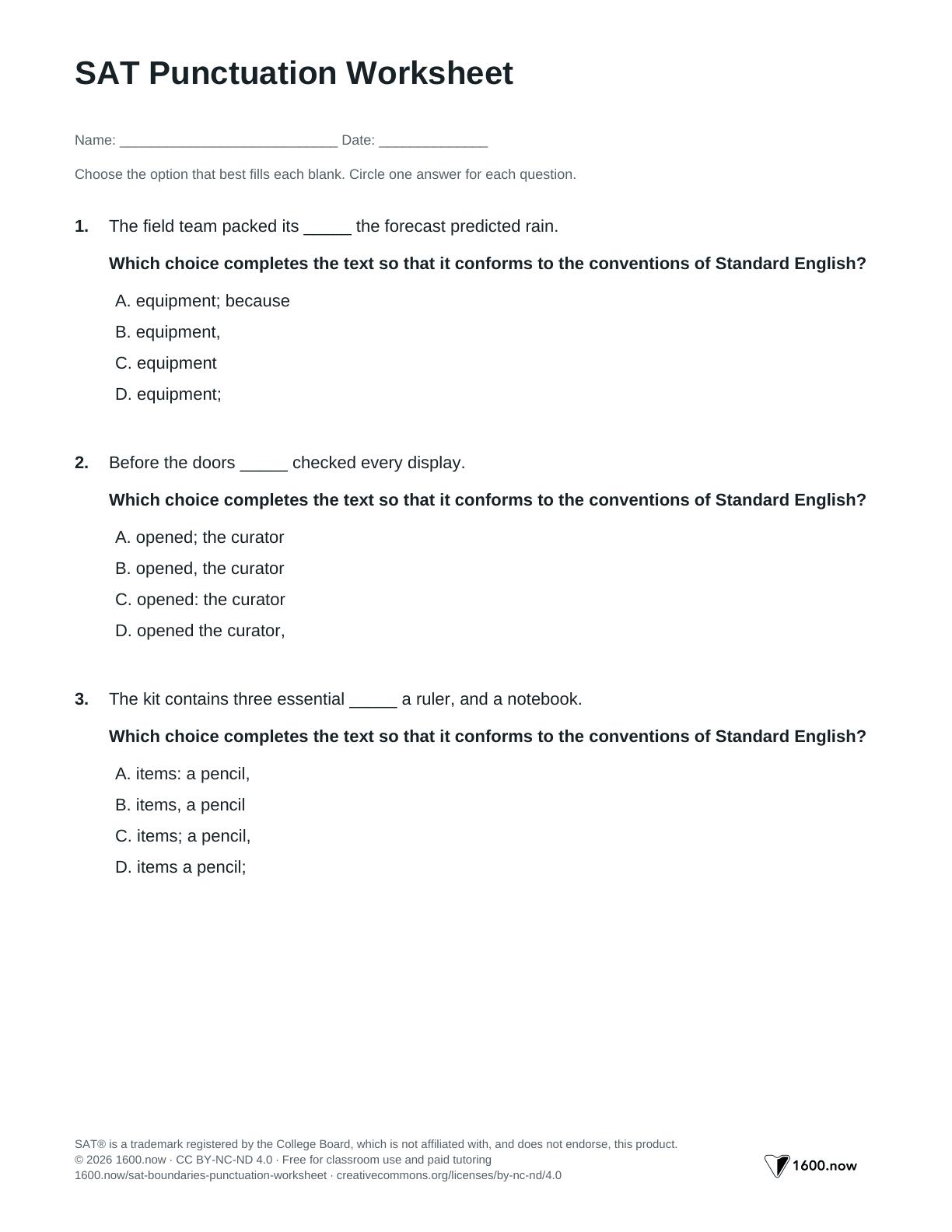
The 12 questions cover sentence boundaries, introductory clauses, appositives, and transitions such as however. Print the student version without solutions or choose the PDF with the explained answer key.
12 questions · about 25 minutes · Standard English Conventions › Boundaries
Share to Google Classroom · This worksheet is free to print and share under CC BY-NC-ND 4.0. Tutors may also use it in paid sessions. If you post it online, please link to this page instead of re-uploading the PDF. These are original questions, not College Board items.
Test whether each clause stands alone
Find the subject and main verb on both sides of the blank, then read each side alone. Words such as because, although, and before can make a clause dependent even when it contains a subject and verb.
Two independent clauses can be separated by a period or semicolon, or joined with a comma plus a coordinating conjunction. However and therefore are not coordinating conjunctions: between independent clauses, use a semicolon before them and a comma after them.
For an inserted description, remove it and check that the sentence still works. Then close the punctuation you opened around the description. Keep a subject joined directly to its verb; a long subject does not justify a comma before that verb.
Try it yourself
Choose an answer.
Questions
Question 1
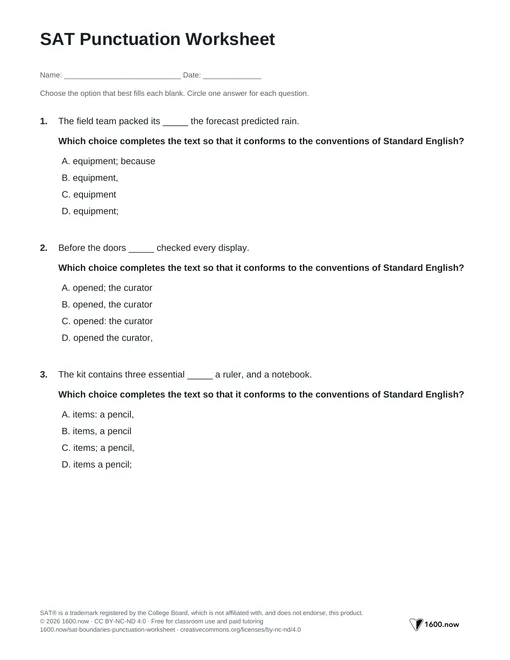
The field team packed its _____ the forecast predicted rain.
Which choice completes the text so that it conforms to the conventions of Standard English?
D. Both sides are independent clauses: the team packed its equipment, and the forecast predicted rain. A semicolon correctly joins them. A comma alone creates a comma splice; no punctuation creates a fused sentence.
Question 2
Before the doors _____ checked every display.
Which choice completes the text so that it conforms to the conventions of Standard English?
B. Before the doors opened is an introductory dependent clause. A comma separates it from the main clause, the curator checked every display. A semicolon or colon cannot follow this dependent clause.
Question 3
The kit contains three essential _____ a ruler, and a notebook.
Which choice completes the text so that it conforms to the conventions of Standard English?
A. The complete clause The kit contains three essential items can introduce a list with a colon. The three list items are a pencil, a ruler, and a notebook.
Question 4
The museum's newest _____ display until December.
Which choice completes the text so that it conforms to the conventions of Standard English?
C. The subject The museum's newest exhibition must connect directly to its verb remains. None of the proposed punctuation marks belongs between this subject and verb.
Question 5
Dr. Amir Rao, a marine _____ the underwater recordings.
Which choice completes the text so that it conforms to the conventions of Standard English?
B. The nonessential appositive a marine biologist begins with a comma and needs a closing comma. The main clause is Dr. Amir Rao analyzed the underwater recordings.
Question 6
The original design was _____, the engineers tested a smaller version.
Which choice completes the text so that it conforms to the conventions of Standard English?
D. Both sides are independent clauses. A semicolon before therefore, with the comma after it, joins them. A comma alone before therefore creates a comma splice, and the semicolon already joins the clauses, so and should not follow it.
Question 7
The telescope was ready _____ clouds prevented the team from observing the comet.
Which choice completes the text so that it conforms to the conventions of Standard English?
A. The independent clauses need a valid boundary. A semicolon before however and a comma after it correctly join the contrasting statements.
Question 8
After the final rehearsal _____ returned the instruments to their cases.
Which choice completes the text so that it conforms to the conventions of Standard English?
B. After the final rehearsal ended is an introductory dependent clause. A comma correctly separates it from the main clause about the musicians.
Question 9
The laboratory requires two safety _____ and a face shield.
Which choice completes the text so that it conforms to the conventions of Standard English?
C. The complete clause The laboratory requires two safety items can introduce the list with a colon. Gloves and a face shield are the two items.
Question 10
The collection of photographs from the coastal _____ in the main gallery.
Which choice completes the text so that it conforms to the conventions of Standard English?
D. The subject collection connects directly to hangs. The prepositional phrases do not create a boundary requiring punctuation before the verb.
Question 11
Mira Chen, the exhibition's lead _____ the opening tour.
Which choice completes the text so that it conforms to the conventions of Standard English?
A. The appositive the exhibition's lead curator begins with a comma and needs a closing comma before the main verb will conduct.
Question 12
The walkway was _____ the garden remained open to visitors.
Which choice completes the text so that it conforms to the conventions of Standard English?
B. A semicolon separates the independent clauses, and a comma follows nevertheless. A comma alone before nevertheless would create a comma splice.
0/12 correct
Check your punctuation answers
Each row is a wrong answer choice from one of the sheet's problems, shown in its sentence, with the rule it breaks.
| What your answer looked like | What actually happened | Fix it next time |
|---|---|---|
| “The field team packed its equipment; because the forecast predicted rain” in problem 1 | The semicolon would be right on its own, but because turns what follows into a dependent clause, so the semicolon now has a fragment after it. | Use one joining tool, not two. Between two complete sentences, the semicolon alone works: “The field team packed its equipment; the forecast predicted rain.” |
| “Before the doors opened; the curator checked every display” in problem 2 | The word before makes “Before the doors opened” a dependent clause, and a semicolon needs a complete sentence on both sides. | End an introductory clause that starts with a word like before, after, or because with a comma: “Before the doors opened, the curator checked every display.” Problem 8 is the same. |
| “The kit contains three essential items; a pencil, a ruler, and a notebook” in problem 3 | A semicolon joins two complete sentences, and “a pencil, a ruler, and a notebook” is a list. | After a complete sentence, introduce a list with a colon: “The kit contains three essential items: a pencil, a ruler, and a notebook.” Problem 9 uses the same pattern. |
| “The museum's newest exhibition, remains on display until December” in problem 4 | A comma between a subject and its verb splits the clause. “The museum's newest exhibition” is the subject, and remains is its verb. | If the blank falls between a subject and its verb, leave it empty. Problem 10 has a longer subject, “The collection of photographs from the coastal villages,” and the same answer. |
| “Dr. Amir Rao, a marine biologist analyzed the underwater recordings” in problem 5 | The comma after Rao opens the extra phrase “a marine biologist,” and nothing closes it before the verb. | Read the sentence without the extra phrase: “Dr. Amir Rao analyzed the underwater recordings.” Put a comma where the phrase starts and another where it ends. Problem 11 works the same way. |
| “The telescope was ready, however, clouds prevented the team from observing the comet” in problem 7 | Both sides of however are complete sentences. The word however is an adverb, not a joining word, so commas around it leave a comma splice. | Put a semicolon before however and a comma after it: “The telescope was ready; however, clouds prevented the team from observing the comet.” Problems 6 and 12 follow the same rule with therefore and nevertheless. |
Worked example: therefore between two sentences
Problem 6 reads: “The original design was _____, the engineers tested a smaller version.” Start with the clauses. “The original design was costly” has a subject and a verb, and so does “the engineers tested a smaller version.” Two complete sentences need a semicolon between them, or a comma with and, but, or so. The word therefore isn't one of them.
Notice the comma already after the blank: whatever you choose, that comma will follow therefore. With the semicolon, the sentence reads “The original design was costly; therefore, the engineers tested a smaller version,” which is correct. A comma alone before therefore makes a comma splice, no punctuation runs the two sentences together, and “costly; and therefore” uses two joining tools where one is enough.
Apply the check to fresh questions
On fresh punctuation questions, mark clause boundaries before looking at the choices. Use the Boundaries practice link to check both sentence joining and paired punctuation.
Review the boundaries (punctuation and sentence structure) method